.jpg)
This is not a routine budget update. Treasurer Jim Chalmers has just delivered the most significant overhaul of Australian capital gains tax in 25 years, and it lands squarely on crypto. If you hold digital assets in Australia, the window to act under the current rules is open, it has a clear expiry date, and the difference between acting inside it and outside it could be tens of thousands of dollars on a meaningful position. This special edition breaks down what is changing, what it means for crypto specifically, and what questions you should be asking right now.
The Headline: CGT Is Getting Overhauled From 1 July 2027
The 50% capital gains tax discount that has been a fixture of personal investing since 1999 is being replaced. From 1 July 2027, instead of halving your taxable gain when you sell an asset held for more than 12 months, your cost base will be indexed to inflation over your holding period, and only the real inflation-adjusted gain enters your taxable income.
On top of that, a new 30% minimum tax will apply to real capital gains for individuals, trusts and partnerships. If your marginal tax rate is already 30% or higher, the minimum tax does not change your position. You pay your normal marginal rate on the real gain. If your marginal rate is below 30%, the floor applies. Pensioners and income support recipients are exempt.
These changes apply to all CGT assets: shares, property, business equity, and yes, crypto. There is no special carve-out for digital assets, no separate regime, and no grandfathering of existing holdings beyond a transitional rule we cover below.
Why Crypto Gets Hit Harder Than Everything Else
This is the part that matters most for Wayex users, and it is worth reading carefully.
The new indexation system was designed for asset classes where a meaningful portion of long-term gains reflects inflation rather than real value creation. Treasury's own modelling shows that over a typical 10-year hold, inflation accounts for somewhere between 35% and 55% of nominal returns on residential property and ASX shares. For those asset classes, indexation does a lot of the same work the 50% discount was doing.
Crypto does not work that way. Most of the gain on a successful crypto position is value appreciation, not inflation. A 5x return on Bitcoin over three years is not happening because of CPI. Indexation might shave a few per cent off your taxable gain, where the 50% discount halves your taxable amount.
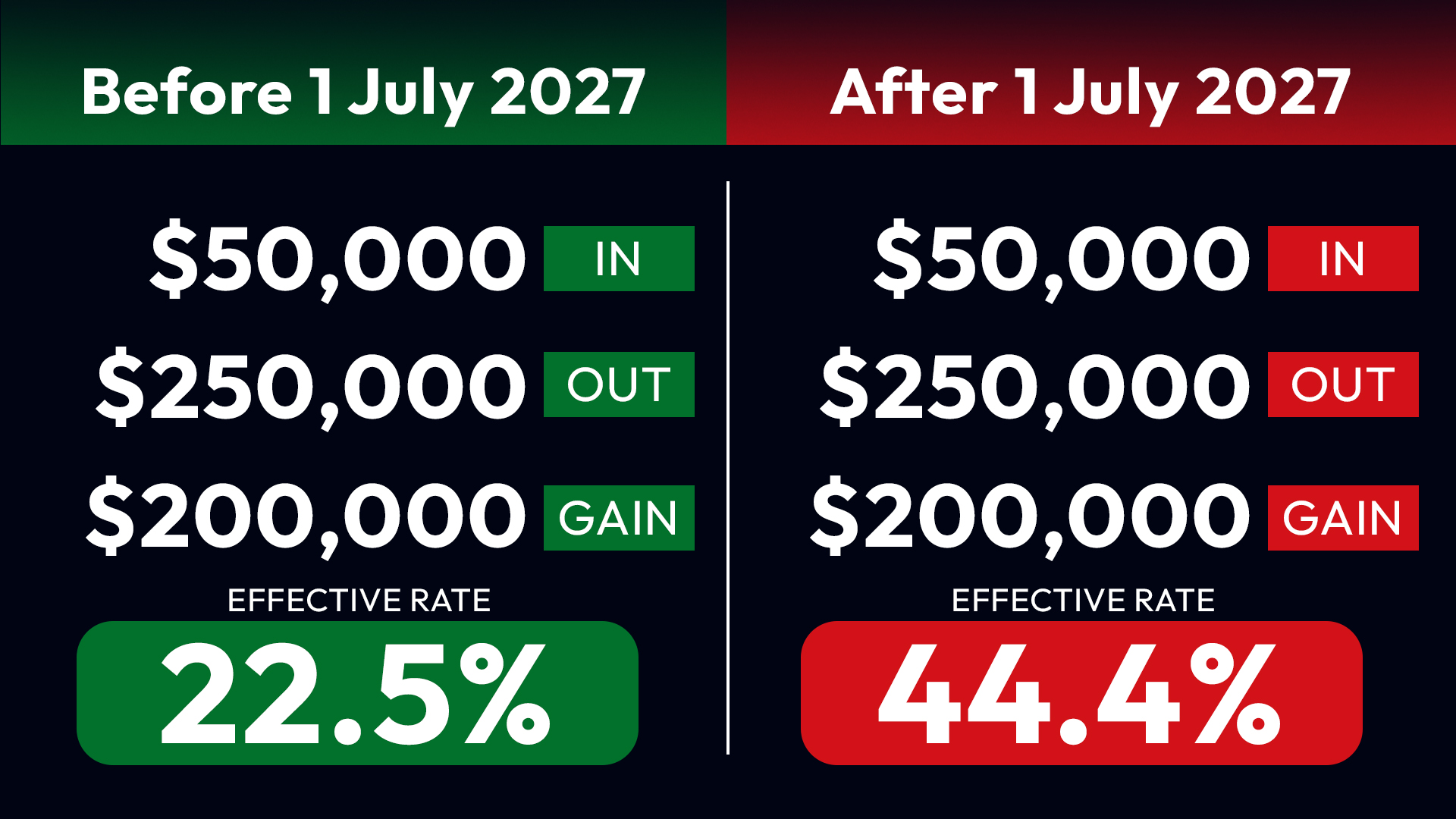
Here is what that looks like in practice. Say you bought $50,000 of crypto and sold it two years later for $250,000. That is a $200,000 nominal gain. You are a top-bracket investor at a 45% marginal rate.
Under current rules, your taxable gain is $100,000 after the 50% discount applies, and you pay $45,000 in tax. Your effective rate on the nominal gain is 22.5%.
Under the new rules from 1 July 2027, your indexed cost base with roughly 5% cumulative inflation over the hold would be around $52,500. Your real gain is $197,500, and at 45%, you pay $88,875. Your effective rate on the same nominal gain is now 44.4%.
That is roughly a doubling of the effective tax rate. Same asset, same investor, same holding period. The numbers shift depending on your situation, but the direction is consistent across the crypto universe, whether you are holding BTC or trading altcoins through your Wayex account.
What Happens to What You Are Holding Right Now
If you are sitting on crypto today and do not sell before 1 July 2027, a transitional rule applies a split treatment when you eventually sell. The portion of your gain that accrued up to 1 July 2027 gets the 50% discount under current rules. The portion that accrued from 1 July 2027 onwards gets indexation plus the 30% minimum tax.
To establish the dividing line, you can either use the market value of your holding as at 1 July 2027 or use an apportionment formula that the ATO will publish tools for. For crypto, Method 1 is the obvious choice. Exchange prices on the day are unambiguous and granular, and platforms like Wayex give you the transaction history and portfolio data you need to establish that valuation cleanly.
The practical implication right now is straightforward: make sure you have a clear record of your portfolio valuation on 30 June 2027. The data is there. You just need to capture it.
The split treatment creates a genuine strategic question for anyone sitting on large unrealised gains. Do you crystallise before 1 July 2027 to lock in the 50% discount entirely, or do you hold and accept the split treatment? The answer depends on where you think the asset is going, what your tax position looks like in 2026-27 versus future years, and whether you are ready to redeploy capital after a realisation event. There is no single right answer. There is now a clear deadline to think about it, though.
The Window: You Have Until 30 June 2027
Any disposal that settles before 1 July 2027 falls entirely under current rules. If you have held for more than 12 months, the 50% discount applies. Standard marginal rates apply to the discounted gain.
That is a 14-month window of clarity from now. It does not mean you should rush a decision. A crystallisation purely to capture the discount only makes sense if you are genuinely comfortable resuming the position at current prices, or if you are happy to exit entirely. Selling and immediately re-buying triggers the gain and gives you a stepped-up cost base, but it exposes you to whatever the market does in the meantime. The tax tail should not wag the investment dog.
Two other things worth knowing. The legislated stage-3 follow-up brings the bottom marginal rate down to 15% on 1 July 2026 and 14% on 1 July 2027. These do not change CGT treatment, but they soften the marginal rate environment for anyone using the discount window. If you hold crypto through a discretionary trust, a three-year rollover relief period runs from 1 July 2027 to 30 June 2030, allowing you to restructure out of that trust into a company or fixed trust without triggering CGT on the asset transfers.
For Wayex users, thinking through the timing, your full transaction history and portfolio performance data is available in your account. That is your starting point for any conversation with your accountant about whether the window is relevant to your position.
.jpg)
What Is Not Changing
Worth knowing what stays exactly as it is. Super funds are explicitly preserved, including the one-third CGT discount on assets held more than 12 months inside an SMSF. Crypto held in a company structure pays company tax on the full nominal gain as before, since companies never had the 50% discount anyway. Negative gearing on margin loans against crypto positions is unaffected. Small business CGT concessions under Division 152 continue unchanged.
The Constructive Part
It is not all hard news. The Budget also confirms the Government's continued engagement with the digital asset sector. A tokenisation and payments reform package has been funded to support regulatory coordination and industry adoption. Treasury is actively analysing the market for a tokenised government bond, a genuine signal that tokenised assets are being treated as mainstream financial infrastructure rather than a fringe experiment. A new strategic plan for payments is being developed that will shape how digital asset payment rails interact with the broader system.
This is the part of the Budget that aligns with everything Wayex has been building toward. Real payments infrastructure, regulatory recognition, and a government that is treating crypto as a legitimate part of the financial system. The personal tax changes are a separate policy lever aimed at intergenerational equity. The industry reading both tracks together should feel cautiously optimistic about where Australia is heading structurally, while being clear-eyed about the personal tax implications in the near term.
.jpg)
Founder's Corner
The Budget handed Australian crypto holders and other Australians who invest something quite disappointing this week. The honest takeaway is that holding crypto as a personal investor in Australia just got more expensive from a tax perspective. That is a fact worth planning around, not panicking about. The 14-month window is enough time to get clear on your position, speak to your accountant, and make a considered decision rather than a reactive one.
When I read what is happening, I was not thinking about those who are already in a wealthier position. I started thinking about the person who put $5,000 into ETH eighteen months ago, did their own research, and now they're sitting on a position that's done well. Not life-changing money. Just a good decision that paid off. Under the current rules, they sell after twelve months and pay tax on half the gain. Simple. Under the new rules, they pay tax on almost all of it, because crypto gains aren't driven by inflation; they're driven by the asset actually appreciating. The indexation adjustment on a two or three-year hold is tiny. A few percentage points off the cost base versus a 50% discount today.
We'll keep building. And we'll keep making sure our users have the tools and the data to make informed decisions, whether that's inside this window or beyond it.
Important: This newsletter is a general summary of announced Budget measures and does not constitute tax, financial or legal advice. Legislation has not yet been drafted, and several technical details remain subject to Treasury consultation. Wayex does not provide tax advice. Please speak with a registered tax agent or financial adviser about your specific circumstances before making any decisions.
**All information in this article is for informational purposes only. You should not construe any such information or other material as legal, tax, investment, financial, or other advice. Nothing contained herein shall constitute a solicitation, recommendation, endorsement, or offer by Wayex to invest, buy, or sell any coins, tokens, or other crypto assets. Any descriptions of Wayex products or features are merely for illustrative purposes. Past performance is not a guarantee or predictor of future performance. The value of crypto assets can increase or decrease, and you could lose all or a substantial amount of your purchase price. It is essential for you to do your research and due diligence to make the best possible judgement, as any purchases shall be your sole responsibility.