This week in crypto feels like one of those moments when the market cannot decide whether to rally, panic, or do both at once. Bitcoin is holding above US$70,000 (AU$98,017) while geopolitical tensions linked to the Iran conflict continue to move global markets, and for the first time in a while, it is showing strength relative to stocks, gold, and the tech sector. At the same time, institutional money is slowly returning through ETFs, major banks are exploring stablecoins, and regulators are tightening their oversight in several regions. All of this shows that crypto is becoming more connected to the traditional financial system, whether the industry likes it or not.
Under the surface, the bigger story this week is infrastructure. Ethereum is working on simpler staking for institutions, Ripple is expanding its licences and acquisitions, Wells Fargo is exploring blockchain payments, and new data shows that decentralised exchanges are slowly gaining market share from centralised platforms. Even with this progress, headlines still include lawsuits, sanctions investigations, hacks, and long-term risks such as quantum computing. The technology continues to develop, money keeps flowing in and out of the market, and the industry keeps expanding, even as the world outside crypto feels uncertain.
What's Happening On The Wayex Platform
.jpg)
Bitcoin Is Beating Gold During the Iran War
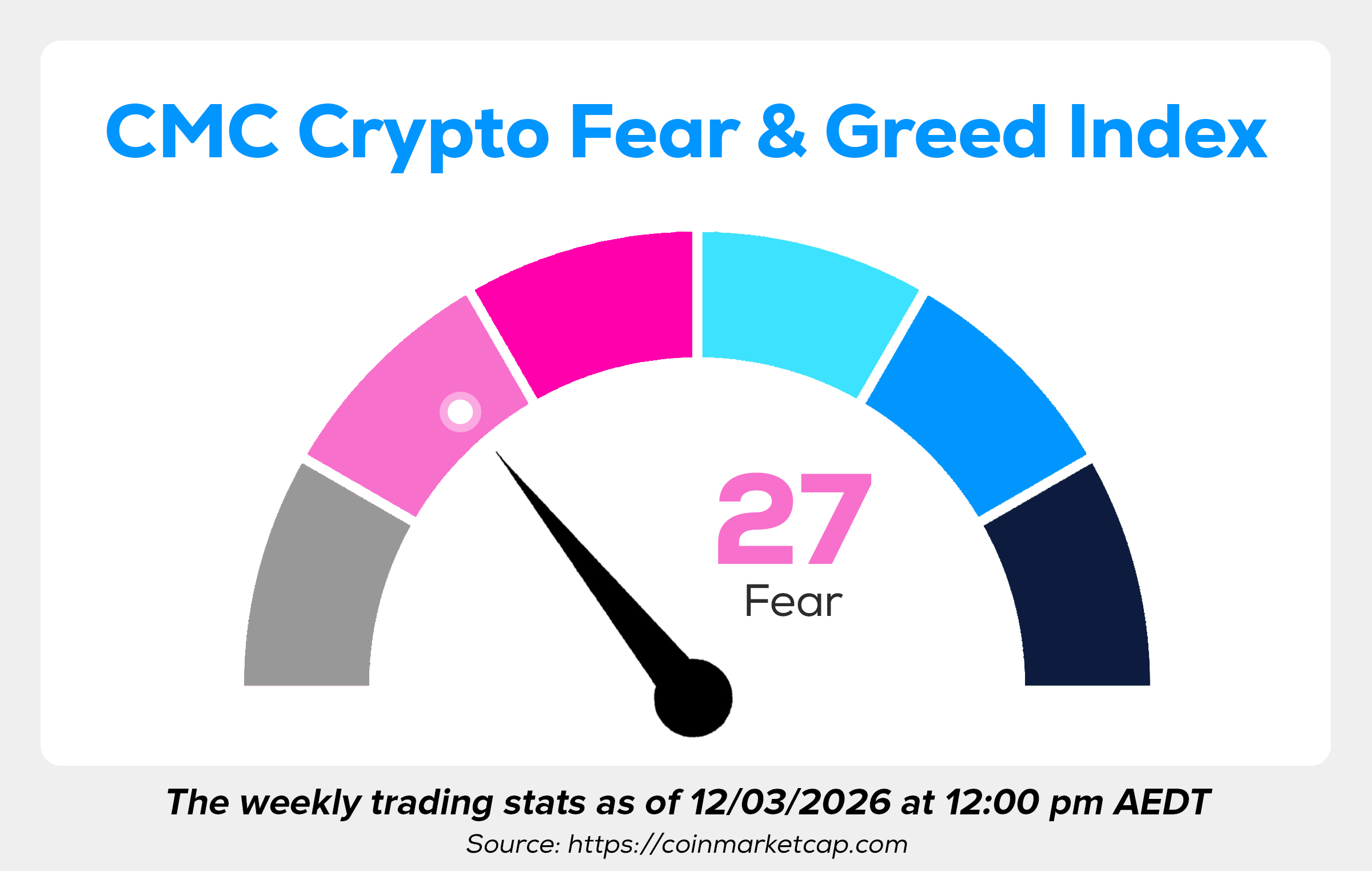
Bitcoin moved above US$71,000 (AU$99,448) this week as global markets reacted to volatility linked to the Iran conflict, with traders watching oil prices and risk sentiment closely. The move followed comments suggesting the war could ease (though commentary on this changes not just daily but hourly). The rumblings of the Trump Administration trying to de-escalate the war are helping stabilise equities and trigger dip-buying across risk assets, including crypto. At the same time, spot Bitcoin ETFs saw about US$170 million (AU$238 million) in inflows, and on-chain data showed improving momentum, although overall conviction remains weak. Bitcoin has gained around 7% this month and has held above US$70,000 (AU$98,047) even as stocks and gold moved mostly sideways, with analysts saying the muted reaction to geopolitical headlines suggests selling pressure may be fading, and the market could be stabilising. Traders are also watching a shift in correlations, with Bitcoin recently rising alongside gold as the US dollar weakens and beginning to break away from the software sector, which had been closely linked to crypto in recent months, while improving flows into spot ETFs, led by BlackRock’s IBIT, are being seen as a key sign that institutional demand may be returning.
However, some analysts warn the rally may still be fragile. Commentary reported by The Street notes that Bitcoin often trades like a high-risk asset tied to global liquidity rather than a true haven, meaning rising oil prices, geopolitical tension, or tighter financial conditions could quickly reverse recent gains. While ETF inflows and stronger price action are encouraging, the asset remains more than 40% below its previous high near US$126,000 (AU$176,485), and traders continue to hedge downside risk amid rising volatility. Until liquidity conditions clearly improve and institutional demand becomes more consistent, some investors believe the current move may remain part of a wider consolidation range rather than the start of a new bull run, showing that confidence has improved but has not fully returned to the market yet.

And, if you aren’t feeling down enough with that little sign off, CoinTelegraph published a blog emphasising that “All 21 million of the Bitcoin supply at risk from quantum computing”, so if you want some fuel for your doom scrolling, you can find the link here.
Binance Sues WSJ Over Iran Claims
Binance has today filed a defamation lawsuit against The Wall Street Journal after the publication reported that the exchange may have been linked to crypto transactions connected to Iran, raising concerns about sanctions compliance. The report claimed that more than US$1 billion (AU$1.4 billion) in transfers may have moved through networks linked to Iranian users, with some transactions allegedly linked to entities associated with Iran-backed groups. Binance strongly denies the allegations, saying the article misrepresented its compliance work and ignored evidence that it continued to monitor transactions and to cooperate with regulators and law enforcement. The exchange says the claims have damaged its reputation at a time when it is already operating under tighter oversight following previous settlements with US authorities.
Additional reporting says the US Department of Justice is investigating whether Iranian networks used Binance to bypass American sanctions, focusing on transactions that allegedly moved through the platform to groups including Yemen’s Houthis. Binance says it is not aware of any active investigation and maintains that it works with regulators where required, while also rejecting claims that it shut down internal compliance reviews.
President Trump, often touted as the pro-crypto President, and his DOJ, are renewing their scrutiny of the industry as policymakers increase their focus on how countries under financial restrictions are using digital assets to move funds outside the traditional banking system. The Trump-led DOJ, which he exercises unprecedented influence over, is rumoured to initiate an investigation into Binance and to continue pursuing enforcement actions, including pushing for a retrial of Tornado Cash founder Roman Storm.
DEX vs CEX: CoinGecko Reports The Numbers
Centralised exchanges (CEXs) still dominate crypto trading, but decentralised exchanges (DEXs) are gaining market share quickly. According to CoinGecko’s latest trading report, CEXs processed nearly US$80 trillion (AU$112 trillion) in trading volume in 2025, underscoring their continued role as the main source of liquidity for both retail and institutional users. However, DEX activity continues to grow, with spot trading share rising from 6.9% in 2024 to about 14% in early 2026, driven by memecoin trading, improved on-chain infrastructure, and a better user experience. Even with this growth, centralised exchanges still handle over US$1 trillion (AU$1.4 trillion) in monthly spot volume, showing the market still depends heavily on large platforms for liquidity.
The report also shows how fast on-chain trading is evolving. Perpetual futures volume has grown about 75% in two years, with DEX share increasing fivefold to more than 10%, led by platforms like Hyperliquid, Uniswap, and PancakeSwap, which now rank among the largest exchanges by volume. At the same time, token creation has surged, with more than 24 million new tokens created in one year, while even the most active centralised exchanges listed only a small fraction of them. Security remains a major risk across the industry, with exchanges losing more than US$2.4 billion (AU$3.3 billion) to hacks and exploits in just over a year, often due to compromised keys, phishing attacks, or smart contract bugs. The data show a market that is growing fast and becoming more decentralised, but still facing core challenges in security, liquidity, and trust.
Big Ripples From Ripple, But Pricing Remains Stagnant
XRP Ledger activity has surged recently, with daily transactions rising above US$2.7 million (AU$3.8 million), one of the highest levels seen in months. Payments, transfers, and other on-chain activity have all increased simultaneously, indicating stronger network usage, but the price has not reacted in the same way. XRP is still trading around US$1.37 (AU$1.92), moving sideways despite rising activity. Reporting from Ahmad Bahala at CryptoNews, the hypothesis is that this disconnect can occur because not every transaction represents new money entering the market, as some activity stems from exchange transfers, internal movements, or automated processes rather than genuine buying demand. Increased network activity can signal growing adoption, but price usually moves only when real capital enters the market.
From a technical perspective, XRP has been slowly recovering after finding support near US$1.12 (AU$1.57) earlier this year and is now trading between rising support near US$1.30 (AU$1.82) and resistance around US$1.50–US$1.61 (AU$2.10-AU$2.25). A breakout above this range could open the way toward US$1.90 (AU$2.66) and possibly US$2.20 (AU$3.08), while a drop below support could send the price back toward earlier lows. Some commentators suggest that stronger institutional use of the XRP Ledger could support higher prices over time. Still, large targets such as US$100 (AU$140) remain highly speculative and would require much wider adoption and sustained demand.
Ripple has also drawn attention after speculation that the company is buying back up to US$750 million (AU$1.05 billion) in shares at a US$50 billion (AU$70 billion) valuation. Although it is being reported by Bloomberg, Yahoo Finance, The Block, and others, we haven't received an official statement from Ripple's team at the time of writing. However, if the news is indeed true, it's a move that suggests continued confidence in the business and the long-term development of the XRP ecosystem. But will this impact the token price…. We'll need to wait and see, I guess.
Wells Fargo From Wagons To Stablecoins
Wells Fargo has applied for a trademark for the name WFUSD, with the filing showing possible use in services related to cryptocurrency, stablecoins, and digital assets. The application was submitted to the US Patent and Trademark Office on March 10 and includes categories covering financial software, trading services, payments, and tools for handling blockchain-based assets. The filing does not confirm that a stablecoin will be launched, but names ending in "USD" are often used for dollar-pegged tokens, which has led to speculation that the bank may be preparing for future digital asset products. The application is still awaiting review, and the approval process can take more than 10 months.
The move also highlights how traditional finance continues to evolve. Wells Fargo was founded in 1852 as a bank and express company and became known for using stagecoaches to transport mail, money, and valuables across the western United States, a role that later became a symbol of reliability and long-term growth for the brand. More than 170 years later, the company is now exploring blockchain, stablecoins, and digital payments, following a trend seen across the banking industry. Western Union and JPMorgan have made similar trademark filings related to digital assets. At the same time, Wells Fargo has already given clients access to Bitcoin ETFs and participated in discussions about possible bank-issued stablecoins. The filing shows that major financial institutions are continuing to prepare for a future in which blockchain-based payments could play a larger role in global finance.
Vitalik Wants One-Click Staking
Ethereum co-founder Vitalik Buterin has proposed making Ether staking much easier for institutions, aiming to reduce technical barriers while keeping the network decentralised. The idea centres on a simplified system called DVT-lite (Distributed Validator Technology lite), which allows multiple machines to share validator duties without the complexity of full distributed setups. The Ethereum Foundation has already tested this approach by staking 72,000 ETH, demonstrating that the model can work in real-world conditions. Buterin argues that staking today remains too technical for many large holders, as running validators requires managing nodes, security, and uptime, which can result in lost rewards or penalties if done incorrectly.

The proposal aims to make staking closer to a standard software deployment, enabling institutions to run validators with simple tools such as containers or automated configurations rather than complex infrastructure. Demand for staking remains strong, with about 37.5 million ETH staked and hundreds of thousands of validators active, indicating continued confidence in Ethereum even amid weaker market conditions. Buterin believes that simplifying staking could bring more institutional capital into the network while avoiding excessive concentration of control in a small number of providers, which is important for Ethereum's long-term security and decentralisation.
Crypto Movements in APAC: Tis The Acquisition Season
Last year, we reported that markets and trendsetters like ourselves (HA) would see big players in crypto expand into new markets through mergers and acquisitions. And Ripple has announced just that, with CoinTelegraph reporting that they plan to secure an Australian Financial Services License (AFSL) through the acquisition of payments firm BC Payments Australia, a move that would allow the company to expand its services in the country as regulation around crypto becomes stricter. The deal, expected to close around April 1, would give Ripple access to the existing licence held by the company, which is likely to become required for crypto firms offering certain financial services in Australia. Ripple APAC managing director Fiona Murray said there is strong institutional interest in digital assets in Australia, and that obtaining a licence has always been part of the company's long-term plan, with the country seen as an important market for its payments business.
Ripple said that holding an AFSL would allow its payments platform to manage the full transaction process, including onboarding, compliance, funding, foreign exchange, liquidity, and final settlement, while combining traditional banking rails with digital assets. The move is part of a wider push by Ripple to expand its regulatory approvals globally, after gaining licences or approvals in the United States, Singapore, the UAE, and the United Kingdom over the past year. The company has been increasing its focus on institutional payments and digital asset infrastructure, and the Australian licence would support its plan to grow cross-border payment services using blockchain technology.
Things That Made Us Laugh This Week


Founder's Corner
This week, Bitcoin’s stability above US70,000(AU98,017) despite geopolitical tension suggests a major shift: crypto is increasingly decoupling from tech stocks and behaving as an independent asset class. With US$170 million in ETF inflows and legacy giants like Wells Fargo filing for stablecoin trademarks, the bridge between traditional finance and blockchain is no longer theoretical; it’s operational. However, with increased integration comes increased scrutiny, highlighted by Binance’s defamation suit against the WSJ and the DOJ’s renewed focus on global compliance.
The industry is rapidly maturing toward a "one-click" future, from Vitalik Buterin’s simplified staking proposals to Ripple’s move to acquire an Australian Financial Services License (AFSL). This move toward regulated, accessible infrastructure is exactly where Wayex lives. As the market shifts from speculation to utility, Wayex remains your compliant gateway, offering the same institutional-grade security and "one-click" ease of use through our Visa Card and NPP/PayID integrations. We are committed to ensuring that, as the financial world evolves, your digital wealth remains as liquid and spendable as the cash in your pocket.
Richard Voice, Co-Founder, Wayex
**All information in this article is for informational purposes only. You should not construe any such information or other material as legal, tax, investment, financial, or other advice. Nothing contained herein shall constitute a solicitation, recommendation, endorsement, or offer by Wayex to invest, buy, or sell any coins, tokens, or other crypto assets. Any descriptions of Wayex products or features are merely for illustrative purposes. Past performance is not a guarantee or predictor of future performance. The value of crypto assets can increase or decrease, and you could lose all or a substantial amount of your purchase price. It is essential for you to do your research and due diligence to make the best possible judgement, as any purchases shall be your sole responsibility.