.png)
From trading at US$1 to an all-time high (ATH) on October 6, 2025, of US$126,080 (AU$176,580), from holding around US$67,000 (AU$93,891), Bitcoin’s journey shows just how far crypto has moved from experiment to system-level force. This week alone captures that shift: markets are digesting strong US jobs data and Extreme Fear sentiment while liquidation waves test whether this is a relief rally or the start of a new leg higher. Sam Bankman-Fried is seeking a new trial amid ongoing political debate over pardons; Australia is tightening its stablecoin framework amid scrutiny of crypto-linked donations; and regulators in the UK and US are pushing to finalise digital asset rules. South Korea’s Bithumb is in damage-control mode after a major internal error exposed exchange control gaps, while stablecoins are pushing further into the mainstream through payroll expansion and rising infrastructure demand. What began as a rebellion against institutions is now reshaping them from within.
What’s Happening On The Wayex Platform
.jpg)
.jpg)
Bitcoin’s $1 Dollarversary: From One Dollar To Now
Bitcoin is holding around US$67,000 (AU$93,891) after briefly bouncing from US$66,000 (AU$92,446) to above US$68,000 (AU$92,489) following the latest US January jobs report. The data showed the US added 130,000 jobs, nearly double the 70,000 expected, while unemployment fell to 4.3%, reducing the likelihood of a March rate cut and keeping pressure on risk assets. Despite mild spot Bitcoin ETF inflows of US$166.5 million (AU$233 million), funding rates remain mixed, and the broader market structure remains cautious, with major altcoins such as Ethereum, XRP, and Solana trending lower.
At the same time, sentiment has plunged into Extreme Fear. The Crypto Fear and Greed Index recently dropped to 6 before recovering slightly to 12, levels that have historically marked major turning points in 2018, the March 2020 COVID crash, the 2021 mid-cycle correction, and the 2022 crypto winter. Bitcoin briefly slipped below US$69,000 (AU$96,719) during a liquidation wave that wiped out billions in leveraged positions, triggering forced selling. While Bitcoin and Ethereum have stabilised, smaller tokens such as PIPPIN, Humanity (H), RIVER, SKY and ASTER have led early rebounds. The key signals to watch now are Bitcoin dominance, funding rates normalising, and whether BTC can hold above the high US$60,000 (AU$84,104) range, which may determine whether this is a short-term relief rally or the start of a stronger recovery cycle.
SBF Petitions For A New Trial
Sam Bankman-Fried has filed a Rule 33 motion seeking a new trial in his New York fraud case. The 35-page filing was submitted pro se, meaning he is representing himself, and was lodged in the Southern District of New York on 10 February 2026, source (CCN); source (CoinDesk). Bankman-Fried is currently serving a 25-year prison sentence after being convicted in November 2023 on seven counts of fraud and conspiracy linked to the collapse of FTX. His mother, Barbara Fried, filed the motion on his behalf due to his incarceration, arguing that new evidence and due process concerns justify another trial, source. He has also asked for Judge Lewis Kaplan to be recused, citing alleged bias, while his separate appeal in the Second Circuit remains pending.
The retrial request comes as political discussions continue regarding a potential presidential pardon. President Donald Trump recently said he would not consider clemency for Bankman-Fried, despite having pardoned other crypto figures, including Binance founder Changpeng “CZ” Zhao and former BitMEX executives. In court filings and on his X account, Bankman-Fried has argued that FTX was not insolvent at the time of its collapse and that investors were not harmed as prosecutors claimed.

However, appellate judges previously noted that the central issue was whether customer funds were misused, rather than the later solvency of the company.The case continues to draw attention across the crypto sector as legal appeals and political speculation unfold in parallel.
AUDD Operators Get a Win And Crypto Political Donations In The Spotlight
ustralia’s crypto sector is heating up on both the regulatory and political fronts. AUDC (AUDD) has secured an Australian Financial Services Licence (AFSL) from ASIC to provide non-cash payment facilities, positioning its AUDD stablecoin within the regulatory framework Australia is moving towards and reinforcing its 1:1 reserve-backed, non-rehypothecated model. At the same time, the Australian Financial Review reports this week that the industry’s growing influence is under scrutiny, with disclosures showing cabinet minister Andrew Charlton, now overseeing digital assets legislation, accepted a AU$49,500 campaign donation from Swyftx prior to the last Federal Election. Not to miss out on a good time, Coinbase donated AU$100,000 to the Labour Party and AU$130,000 to the Liberal Party, and SwyftX also contributed AU$105,000 to the Liberals. Australia currently lacks real-time donation laws, which is why these donations are only coming to light in past election cycles.
It goes without saying that there is nothing wrong with donating to a political party, and cryptocurrency companies were key donors in the 2024 U.S. election cycle.
It’s interesting to see how crypto began as a rebellion against traditional institutions, yet it is now becoming part of the mainstream financial system. What started as a challenge to the status quo is now reshaping it from within. As someone who appreciates a bit of irony, I have to admit, it’s a fascinating full-circle moment.
UK Crypto Rules Near Finalisation as US Market Clarity Act Faces Pressure
Regulatory momentum is building on both sides of the Atlantic, with the UK Financial Conduct Authority confirming it will finalise its digital asset framework in early summer and signalling it is “open for business” for crypto firms. The proposed regime, built on last year’s Treasury draft legislation, will formally bring activities such as issuing qualifying stablecoins, safeguarding digital assets, operating trading platforms, intermediation and staking under the FCA’s remit, with implementation ready once legislation is passed. The FCA has also released its final consultation paper outlining how Consumer Duty will apply to crypto firms and how international players will be treated, while backing UK-issued sterling stablecoins through its regulatory sandbox and an upcoming “stablecoin sprint”.
In the United States, Treasury Secretary Scott Bessent is urging Congress to pass the Digital Asset Market Clarity Act before the spring legislative window closes, arguing that clear market-structure rules are essential to U.S. bitcoin and crypto sovereignty amid ongoing volatility. As we have reported, debate around the bill centres on stablecoin yields and regulatory oversight, with exchanges warning about competitiveness and banks raising concerns about deposit outflows. Major crypto players remain divided on the legislation, but Trump’s Treasury Secretary Bessent maintains that legislation is preferable to leaving markets in a legal vacuum. In another interesting development, he has reinforced the administration’s pro-crypto stance by confirming that the U.S. will stop selling seized BTC and instead retain it in the Strategic Bitcoin Reserve under Executive Order 14233, positioning the country to keep innovation and capital onshore.
South Korean Exchange in Damage Control After Fund Loss
South Korea’s Bithumb has admitted that serious internal failures led to the mistaken transfer of approximately US$40 billion (AU$56 billion) in bitcoin to customers instead of a planned payout of 620,000 won, roughly US$428 (AU$599). The exchange accidentally sent 620,000 bitcoins, far more than its reported 42,000 bitcoin holdings. According to Reuters, the error caused bitcoin prices on Bithumb to fall by 17% and exposed major weaknesses in the platform’s asset-matching and account-segregation controls. CEO Lee Jae-won told a parliamentary committee that a 24-hour delay in transaction processing and balance updates contributed to the mistake. He admitted the exchange failed to properly match transfer amounts to its real holdings and did not separate the funds into a protected account.
South Korea’s Financial Supervisory Service said it will investigate “high-risk” trading practices that threaten market order, including large-scale price manipulation by so-called whales, trading schemes tied to suspended deposits and withdrawals, and coordinated pump activity driven by social media misinformation. The regulator also plans to introduce automated tools to detect suspicious trading patterns in real time and use artificial intelligence to flag potential market abuse. Lawmakers expressed strong concern about weak oversight in one of the world’s most active crypto markets, where around 10 million people now invest in digital assets. Members of parliament said the incident highlights serious gaps in both corporate controls and government oversight, especially given that local exchanges generate trillions of won in annual revenue.
South Korea’s Financial Supervisory Service has a reputation for being tough, proactive and fierce.
Stablecoins Are Trending
MoonPay says it plans to help around 40,000 businesses in the United Kingdom and the European Union pay workers in stablecoins. The company has partnered with payroll and human resources platform Deel to deliver the service. Payments will run through MoonPay’s fiat infrastructure subsidiary, Iron, allowing employers to send stablecoins directly to employees’ crypto wallets.
The rollout will start in the UK and the EU, with plans to expand into the United States. Iron founder and CEO Max von Wallenberg said Deel will use Iron’s payment rails to power fast and scalable global stablecoin payroll. Deel processed US$22 billion (AU$30.7 billion) in global payroll in 2025, showing the size of the opportunity. The company has supported crypto payments since 2021, when it enabled payouts in USDC and Solana, and it raised US$425 million (AU$632 million) in a Series D funding round that same year. The move also reflects growing demand for stablecoin infrastructure more broadly, with Bridge recently reporting its highest inbound enquiries in the past six months as businesses explore stablecoin settlement and payroll solutions.
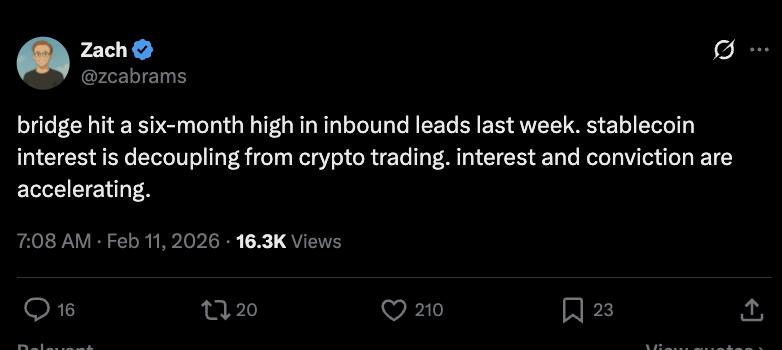
A quick disclaimer: Bridge is Wayex Global’s stablecoin card partner.
Late last year, self-custody wallet firm Exodus Movement partnered with MoonPay and M0 to launch a U.S. dollar-backed stablecoin, further signalling continued expansion in the stablecoin payments space.
Binance Faces Renewed Heat Over WLD1
According to reporting by Forbes, Binance now controls approximately 87% of USD1’s circulating supply, equating to around US$4.7 billion (AU$6.6 billion) of the US$5.4 billion (AU$7.5 billion) total supply, making it the most concentrated major stablecoin position held on a single exchange. Blockchain data cited by Arkham Intelligence shows these holdings are held across Binance-managed wallets and customer accounts. CCN reported that Binance’s U.S. entity holds only around US$1,100 (AU$1,540), reflecting offshore custody following its 2023 U.S. Treasury settlement, according to the source. USD1, launched in March 2025, has rapidly grown into one of the largest stablecoins by market capitalisation, supported by aggressive exchange-led distribution and a US$40 million (AU$56 million) $WLFI promotion that incentivised users to hold the token. Critics argue that such concentration is unusual compared to peers and may create liquidity, governance and operational risks if redemption flows or exchange decisions shift suddenly.
The controversy extends beyond market structure. World Liberty Financial, which issues USD1, is partly owned by a Trump-affiliated LLC holding about 38%, and profits by investing USD1 reserves in U.S. Treasuries, yielding around 3.6%, source. MGX, a UAE-backed fund, previously deployed US$2 billion (AU$2.8 billion) worth of USD1 into Binance, further embedding the stablecoin within the exchange’s ecosystem following the wind-down of BUSD, source. Debate intensified after Binance founder Changpeng Zhao received a presidential pardon in October 2025, with some commentators questioning the timing of Binance’s expanded USD1 promotions, which are “incredibly rare,” according to Independent Crypto Research, Molly White. This, in conjunction with Zhao’s US$1.8 billion (AU$2.5 billion) donation toward crypto initiatives, though no regulatory body has presented evidence of coordination or wrongdoing.
However, it highlights broader tensions in crypto between centralised distribution efficiency and concentration risk, particularly as stablecoins become more intertwined with politics, regulation, and institutional capital flows.
Things That Made Us Laugh This Week


Founders Corner
Bitcoin’s journey from a US$1 to its US$126k ATH proves it is no longer just a trend, but something that the world sees as a valuable asset. While "Extreme Fear" currently rattles speculators, history suggests these moments of panic are the final washout of weak hands before the next major cycle.
There is a fascinating irony playing out in the Australian market right now. We never wanted to go head-to-head with the "big banks" and the status quo, yet here we are: stablecoin operators like AUDD are securing AFSL licenses, and major crypto players are donating hundreds of thousands to political parties.
However, the "Bithumb blunder", accidentally sending US$40 billion in Bitcoin, is a stark reminder of why centralisation still carries massive operational risks. It proves that legacy-style exchange controls often can't keep up with the speed and transparency of the chain. When the South Korean FSS steps in, it signals that the "Wild West" era is being forced to mature. Whether it’s stablecoin payroll for 40,000 businesses or the concentration of tokens like USD1, the message is clear: utility is winning, but the infrastructure needs to be bulletproof. We’re staying focused on building those indestructible rails.
Richard Voice, Co-Founder, Wayex
**All information in this article is for informational purposes only. You should not construe any such information or other material as legal, tax, investment, financial, or other advice. Nothing contained herein shall constitute a solicitation, recommendation, endorsement, or offer by Wayex to invest, buy, or sell any coins, tokens, or other crypto assets. Any descriptions of Wayex products or features are merely for illustrative purposes. Past performance is not a guarantee or predictor of future performance. The value of crypto assets can increase or decrease, and you could lose all or a substantial amount of your purchase price. It is essential for you to do your research and due diligence to make the best possible judgement, as any purchases shall be your sole responsibility.