.png)
The crypto market has entered one of its most volatile stretches of the year, with Bitcoin slipping below US$90,000 (AU$138,829) and multiple indicators flashing uncertainty across the sector. Traders are watching key support zones closely as liquidity builds around primary technical levels, while death cross formations, ETF outflows, and sharp macro shocks have deepened the month-long slump. Retail investors are retreating, whales are selling, and institutional outflows hit US$2 billion (AU$3 billion) last week amid intensifying monetary policy uncertainty. Yet despite the turbulence, analysts say Bitcoin’s correction still aligns with long-term cycle behaviour, with possible short-term rebounds emerging if liquidity holds. At the same time, the broader industry is facing its own pressure points: major exchanges are under renewed scrutiny for compliance failures, hard questions are being raised about Michael Saylor’s Bitcoin strategy, and new listings like Kraken’s confidential IPO signal continued momentum in public markets. Against this backdrop, crypto traders are navigating rapid price swings, shifting sentiment, and heightened regulatory noise, all while major events like AusCryptoCon are set for this weekend, a reminder of the innovation and energy still driving the space forward.
Bitcoin Drops
Bitcoin briefly slipped below US$90,000 (AU$138,791) in mid-November, prompting traders to closely watch a historically significant support zone that often triggers short-term rebounds. Brave New Coin noted that increased order flow appeared around US$90,000 (AU$138,791) as liquidity accumulated. Analyst Ali Martinez from @Ali_charts has noted that recent death crosses have marked local bottoms. However, he warned that a similar pattern in 2022 led to a prolonged bear market, leaving the current formation uncertain. According to Bitcoin, it is currently trading at around US$90,000 (AU$138,791), down sharply from its October peak of US$115,000 (AU$177,365). On-chain data shows accumulation between US$89,800(AU$138,498) and US$90,000 (AU$138,791), a range that has historically preceded 5 to 8% corrective rallies. Key resistance sits between US$96,000 (AU$148,061) and US$99,000 (AU$152,688), and analysts say any move toward US$97,000 (AU$149,603) or a breakout toward US$107,000 (AU$165,026) would require consecutive daily closes above trendline resistance supported by substantial volume. A bearish ABCD pattern and support near US$83,800 (AU$129,245) are also being monitored to determine whether Bitcoin is completing its correction or setting up for deeper declines. Historically, Bitcoin corrections follow multi-year cycles, with prior accumulation zones forming around US$50,000 (AU$77,115) and US$30,000 (AU$46,269). Institutional activity remains mixed, with crypto ETPs recording US$2 billion (AU$3 billion) in outflows last week amid monetary policy uncertainty. Despite the volatility, many analysts view dips like this as part of Bitcoin’s broader cyclical reset, with short-term rebounds possible if liquidity holds and key support levels remain intact.
The rapid swings highlight that even with a more crypto-friendly United States administration and eased SEC oversight, Bitcoin continues to behave like a highly speculative asset. With a fixed supply of 21 million coins and a small number of whale accounts controlling significant holdings, large trades can trigger fast market drops. Because exchanges sometimes limit daily liquidations to prevent cascading crashes, smaller investors may be unable to sell during peak volatility. Broader market downturns make the problem worse, as Bitcoin and crypto ETFs are often the first assets investors sell when fear rises.
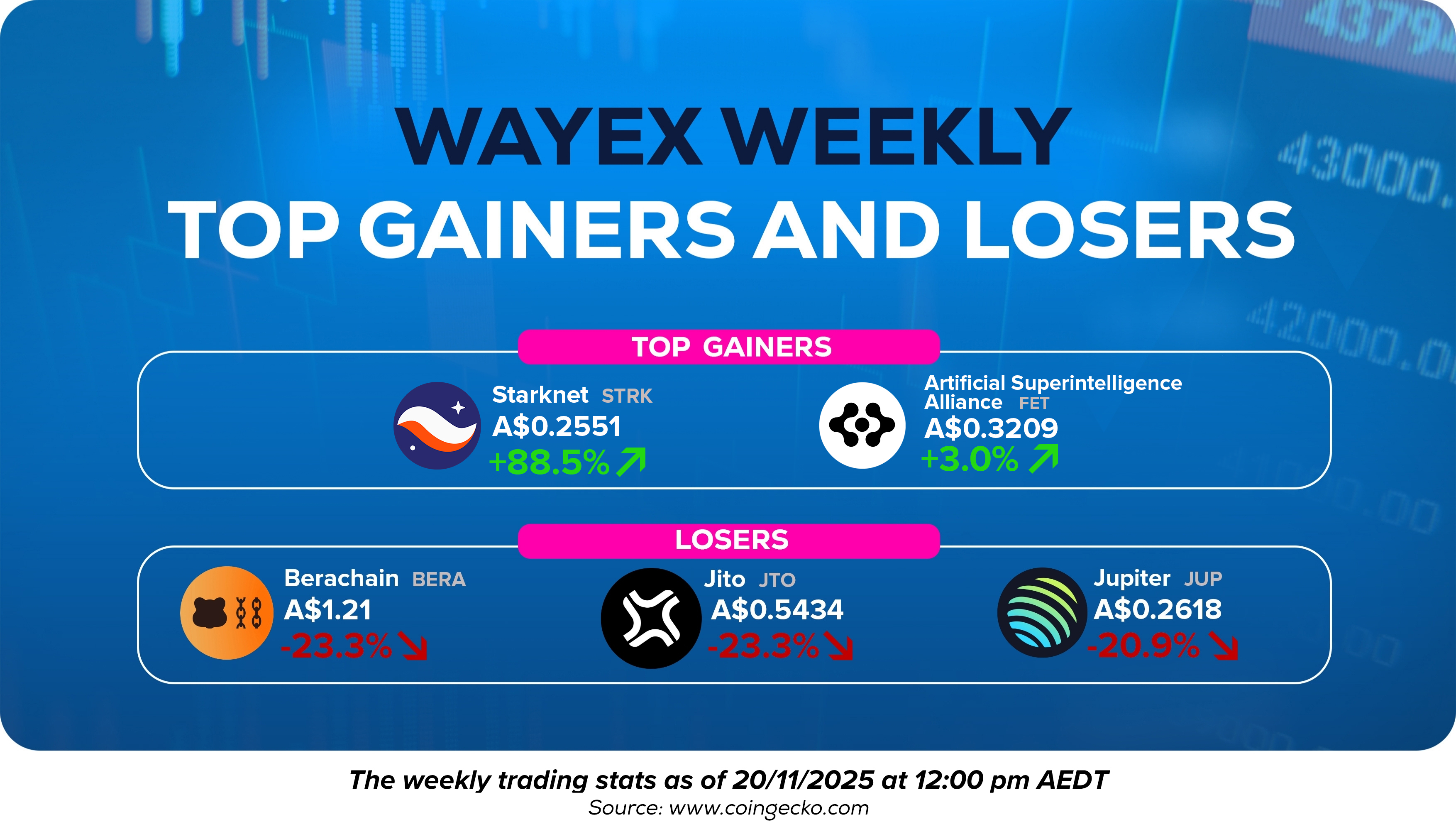
What's Happening On The Wayex Platform This Week
.jpg)
Retailers Flee, But Is This Just A Normal Cycle?
An accelerating exodus from exchange-traded funds has deepened Bitcoin’s month-long slump, erasing all year-to-date gains and sending the price briefly below US$93,714 (AU$144,560) before stabilising near US$95,000 (AU$146,543). Bitcoin has now fallen 25 per cent from its record US$126,251 (AU$194,711) just over a month ago. Analysts attributed last week’s 10% slide to institutional selling, whale reductions, and technical stress, as investors withdrew US$1.8 billion (AU$2.7 billion) from Bitcoin and Ethereum ETFs, including $870 million (AU$1.3 million) from Bitcoin funds on Thursday, the second-largest single-day outflow since their debut. BTC Markets analyst Rachael Lucas said the withdrawal “signalled a clear risk off shift from big money,” coinciding with Bitcoin breaking US$95,000 (AU$146,540) for the first time in six months and forming a death cross. This bearish technical pattern indicates weakening momentum. The backdrop has been worsened by President Trump’s additional 100% tariff on Chinese imports, which triggered the largest liquidation event in crypto history. Major buyers such as ETF allocators and corporate treasuries have since stepped aside. In contrast, Bitcoin treasury stocks, led by Michael Saylor’s Strategy, have halved in value over the past six months. Citi analysts also warned of a decline in crypto whales, saying long-time holders of more than one thousand Bitcoin have turned to selling as speculative assets fall out of favour and tech stocks enter their sharpest correction since early in the year.
Despite the turbulence, analysts remain divided on Bitcoin’s next move. IG Market Analyst Tony Sycamore said Bitcoin is “at a crossroads” and must reclaim its 200-day moving average near US$110,000 (AU$169,653) to signal the end of the bear market, warning that failure to hold support in the low US$90,000 (AU$138,807) range could open a path toward US$85,000 (AU$131,115) or even US$75,000 (AU$115,689). BTC Markets highlighted $88,000 US (AU$135,742) to $ 91,000 US (AU$140,370) as a critical floor, noting that Bitcoin has repeatedly endured deep pullbacks before recovering. Rachael Lucas added that “we are likely at the tail end of this bear phase”. Still, she emphasised that the macro backdrop is different this time, with the United States government reopened, rate cuts pending, and the Federal Reserve preparing to end quantitative tightening in December. MHC Digital Group remains constructive on the medium-term outlook, with Head of Markets Edward Carroll saying institutional investors will likely view the sell-off as a buying opportunity: “This pullback reflects tight funding conditions and shifting rate expectations, not a break in crypto fundamentals. Once the liquidity cycle turns, we expect digital assets to rebound first.”
Wayex’s Tips to Survive Every Market
We say it every week, but crypto really is volatile. Right now, we are watching some of the worst traders in the space get liquidated, and if you are anything like me with an unhealthy addiction to Crypto X (formerly Twitter), you will have seen the panic. People are fleeing the market, posting meltdown memes, and even McDonald’s is joining in on the “Crypto Twitter job application” jokes.

At Wayex, we don’t think there is enough information yet to name this latest phase definitively. But we do believe it’s essential to take care of yourself while everything is swinging around.
In crypto, a long-term strategy is your strongest edge in a market built on constant volatility. To help with this, you can use our new AutoBuy feature, which enables you to execute your long-term strategy with ease. In crypto, community is at the centre of everything. Invest in projects you personally believe in, but also make sure you have parts of your life that are not tied to the charts.
Crypto Exchanges Face Money Laundering Accusations
A new investigation by the ICIJ shows that while the crypto industry is growing quickly and becoming more mature, some major exchanges still have significant gaps to address. Binance and OKX, even after pleading guilty to compliance failures and operating under court oversight, continued to receive large amounts of suspicious funds from crime groups and high-risk networks. Binance received more than US$408 million (AU$629 million) from the Huione Group, a major scam and money-laundering operation, and OKX received more than US$161 million (AU$248 million) after Huione was officially flagged as a money-laundering concern. To their credit, Binance said it works closely with global law enforcement and is a leader in identifying and responding to suspicious deposits, adding that its compliance team investigates users who interact with risky services, but noting that crypto technology does not allow exchanges to block incoming transactions. OKX said it invests heavily in compliance, has already taken proactive steps to restrict related accounts and has been working with the US government, sometimes even initiating engagement itself. These responses show the industry is trying to improve, but also highlight how quickly bad actors can exploit open blockchain systems.
The investigation also found that crime-related flows touched other major platforms, showing this is an industry-wide challenge rather than a problem with one exchange. A Binance-hosted wallet linked by the US Treasury to the Sinaloa cartel received almost $700,000 US (AU$1.07 million), with nearly all of it coming from Coinbase accounts. Funds from Chinese fentanyl traffickers were sent to OKX, and a Russian money launderer tied to North Korea’s weapons program held an active account on HTX. When questioned, Coinbase said it was aware of the cartel-connected transactions and that its work with the US government led to the wallet being sanctioned. In contrast, OKX said it worked proactively with law enforcement and was privately thanked for its efforts. Binance did not answer specific questions about the Sinaloa activity, and HTX did not respond. Overall, the investigation does not undermine crypto itself. However, it does show that some exchanges still need stronger controls and faster response systems to stop criminals from abusing a technology that is otherwise transparent, powerful and valuable for legitimate users.
Kraken Files For A Confidential IPO
Kraken’s confidential plan to go public has added fresh momentum to a wave of crypto listings in the United States, where market sentiment has strengthened under President Donald Trump’s pro-crypto agenda. A person familiar with the matter told CNBC that Kraken has filed confidentially, though the company declined to comment on timing. The move follows a series of major public market entries from crypto firms since Trump returned to the White House, including Bullish and Gemini Space Station, which listed in August and September, and stablecoin issuer Circle, which raised just over $1 billion US (AU 1.5 billion) in a major IPO in June. Analysts say Kraken’s IPO signals that digital asset exchanges are here to stay, noting that the US market is shifting toward innovation, expanded asset choice and deeper payment capabilities. Earlier this week, Kraken announced it was valued at $20 billion US (AU$30 billion) after raising US$800 million (AUD$1.2 billion), including US$200 million (AU$308 million) from Citadel Securities, marking a 33% jump in less than two months. Kraken was founded in 2011 with the exchange and has recently expanded into tokenised equities trading for clients in the European Union. The firm plans to use its new capital to scale its products, expand its payments infrastructure, and aggressively expand into overseas markets. With midterm elections less than a year away, analysts expect crypto companies to accelerate IPOs to get ahead of potential political and regulatory uncertainty. Grayscale and BitGo are also progressing through the IPO pipeline as the sector continues its push into the public markets.
Is MSTR Hurting Bitcoin’s Pricing Action?
Bitcoin’s drop below US$90,000 (AU$138,822) this week has pushed nearly every 2025 investor into the red, including Strategy, one of the world’s largest corporate Bitcoin holders. The fall has intensified criticism of Michael Saylor’s aggressive Bitcoin accumulation strategy, which some analysts argue is hurting Bitcoin’s price performance and drifting away from its original purpose as sovereign, censorship-resistant money. Saylor maintains that Strategy can survive extreme volatility, telling Fox the company could withstand an 80 to 90% drawdown and continue operating. He noted that Bitcoin has experienced 15 major corrections over 15 years, always returning to new all-time highs, and pointed out that annualised volatility has fallen from about 80% in 2020 to around 50% today. He also reiterated that Strategy’s corporate debts are convertible, meaning lenders cannot force the company to liquidate its holdings even if Bitcoin fell to zero. Critics, however, say the real issue is not forced selling. They point to Strategy’s valuation metric, mNAV, slipping below 1 this week to 0.93, signalling that markets now value the firm at less than the Bitcoin it holds, a threshold analysts consider dangerous because it restricts access to capital and strains operational stability.
Analysts at Samosa Capital Investment Fund and economists like Vinny Lingham warn that Strategy’s debt-driven structure now poses broader risks to the Bitcoin ecosystem, especially given that roughly 40% of the company’s total 649,870 BTC holdings are currently in the red. Bitcoin critic Peter Schiff has called Strategy’s model a fraud and predicted that MSTR will eventually go bankrupt. Market commentators have also accused Saylor of buying aggressively during rallies but staying quiet during downturns, even as Bitcoin has fallen more than 25% since early October. They argue that if the Strategy’s discount widens further, the company may eventually need to sell Bitcoin to service its interest obligations, particularly if Bitcoin continues to slide. Although Strategy survived deeper valuation stress in May 2022, when mNAV bottomed at 0.71, analysts note the firm held significantly less Bitcoin and carried far lower debt at the time. With Bitcoin weakening, Ethereum losing key support levels, and over US$1 billion (AU$1.5 billion) in leverage wiped out in a single day, the macro environment is deteriorating quickly. Whether Saylor’s certainty prevails or Strategy’s balance sheet is approaching a breaking point may become clear long before Bitcoin returns to new highs. MSTR has continued to buy BTC, purchasing 8375 coins last week, whilst Huobi founders shelved their own plans for a crypto treasury amid market volatility. MSTR is not the only big player buying this week, as El Salvador has brought US$100 million (AU$154 million) in bitcoin.
Things That Made Us Laugh This Week



Founder's Corner
What a week. Bitcoin dipping under US$90k has everyone on edge, but this kind of volatility is normal for crypto and often clears the way for what comes next. Even while the headlines focus on fear, builders are delivering, exchanges are preparing for public listings and the industry is still moving fast as we head into AusCryptoCon. The Wayex team is excited to be there and to present the Whale Lab with XDC Network, Labrys and Hashlock, so if you are attending, come say hi in Sydney.
Richard Voice, Co-Founder, Wayex
**All information in this article is for informational purposes only. You should not construe any such information or other material as legal, tax, investment, financial, or other advice. Nothing contained herein shall constitute a solicitation, recommendation, endorsement, or offer by Wayex to invest, buy, or sell any coins, tokens, or other crypto assets. Any descriptions of Wayex products or features are merely for illustrative purposes. Past performance is not a guarantee or predictor of future performance. The value of crypto assets can increase or decrease, and you could lose all or a substantial amount of your purchase price. It is essential for you to do your research and due diligence to make the best possible judgement, as any purchases shall be your sole responsibility.