This week in crypto feels like a market that has finally decided to stop apologising for the chaos and just get on with it. The S&P just posted its biggest recovery since April, liquidity is improving, and risk appetite is returning. The backdrop is anything but clean, though.
The Clarity Act is stalled in the Senate, Justin Sun is suing the Trump-backed World Liberty Financial project, and a fresh wave of insider trading accusations is keeping politics and crypto uncomfortably tangled. Still, institutional money isn't waiting for the noise to settle.
Strategy made its third-largest Bitcoin purchase on record, acquiring 34,164 BTC for US$2.54 billion (AU$3.97 billion). BlackRock's ETF added another US$39.3 million (AU$61.4 million) in Bitcoin. Bitmine staked US$7.88 billion (AU$12.3 billion) worth of ETH in a single portfolio call, representing 68% of its entire holdings.
Under the surface, the infrastructure story keeps quietly building, with DoorDash trialling stablecoin payouts, prediction markets racing toward crypto perpetuals, and Apple entering a post-Tim Cook era that leaves its relationship with digital assets genuinely open for the first time. Bitcoin holding above US$74,000 (AU$115,500) and ETH showing early signs of a bullish EMA cross are telling you the same thing the institutional flow is. The signal is getting clearer, even if the path forward remains uneven.
What's Happening on the Wayex Platform


Fed Says Crypto Is Fabric of Finance. The Markets Say Prove It
Federal Reserve Governor Kevin Warsh delivered what should have been a landmark moment for crypto this week, declaring that digital assets are already woven into the fabric of America's financial services industry. Coming from inside the central bank, that is not a throwaway line. It is the kind of institutional acknowledgement the industry has been pushing toward for years, and it signals that the conversation at the highest levels of US finance has shifted from "if" to "how."
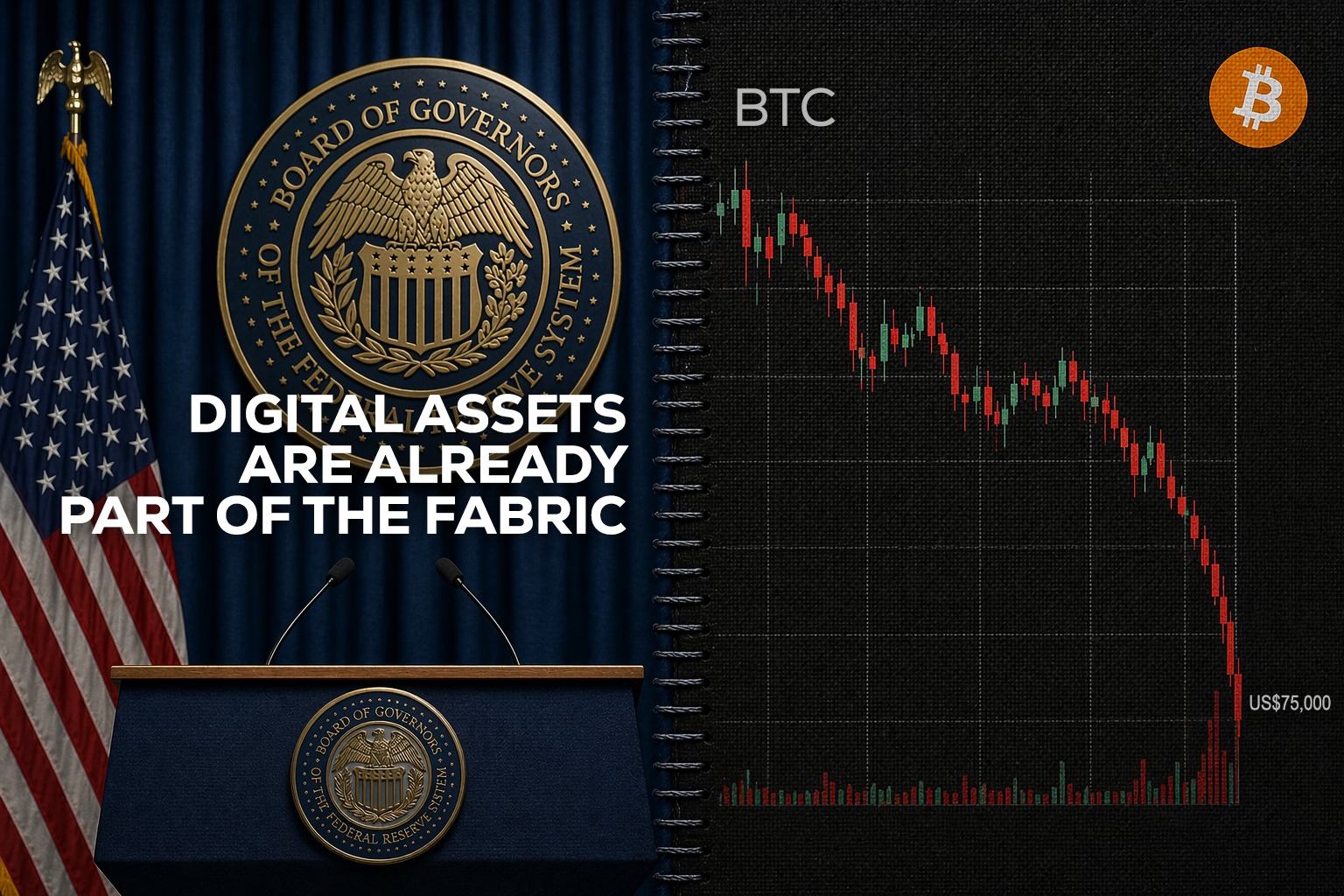
Markets didn't celebrate, though. Bitcoin slid toward US$75,000 (AU$117,000) as Warsh simultaneously clarified that President Trump never directly pressured him to cut interest rates, deflating rate-cut hopes that had been quietly supporting risk appetite across crypto and equities alike. The result was a week that captured the exact tension the market is living in right now: the long-term structural case for crypto has never been stronger, while the short-term macro environment is still dictating price, and it isn't ready to give ground easily.
The takeaway isn't bearish. Credibility from institutions and central bankers is coming, just not on a timeline that satisfies traders. The foundation is being laid. The market just hasn't decided to price it in yet.
The Clarity Act Is Running Out of Road
Crypto's best legislative hope in the Senate is running out of runway. The Clarity Act, widely considered the most consequential piece of US crypto regulation in years, has hit a calendar crunch that insiders say could push meaningful progress out further than the industry would like. The bill still has a path, but it is narrow, and every week of delay is a week that competitors in more progressive jurisdictions are happy to absorb.
The sticking point, as it so often is, comes down to yield. The debate over whether stablecoin issuers should be permitted to pass interest on to users has exposed a fault line between traditional banking interests and crypto advocates that nobody in Washington seems eager to resolve cleanly. Banks are warning of deposit outflows. Crypto advocates are arguing the risks are overstated. In the middle of that standoff, the broader bill sits waiting.
For an industry that has spent years operating in legal grey zones, the cost of this delay is not abstract. Regulatory certainty shapes where capital flows, where companies incorporate, and where talent builds. The US has a genuine opportunity to set the global standard here. Whether it takes it, or cedes that ground to Hong Kong, the EU, or the UAE, will be one of the defining policy stories of 2026.
Smart Money Doesn't Wait for Permission
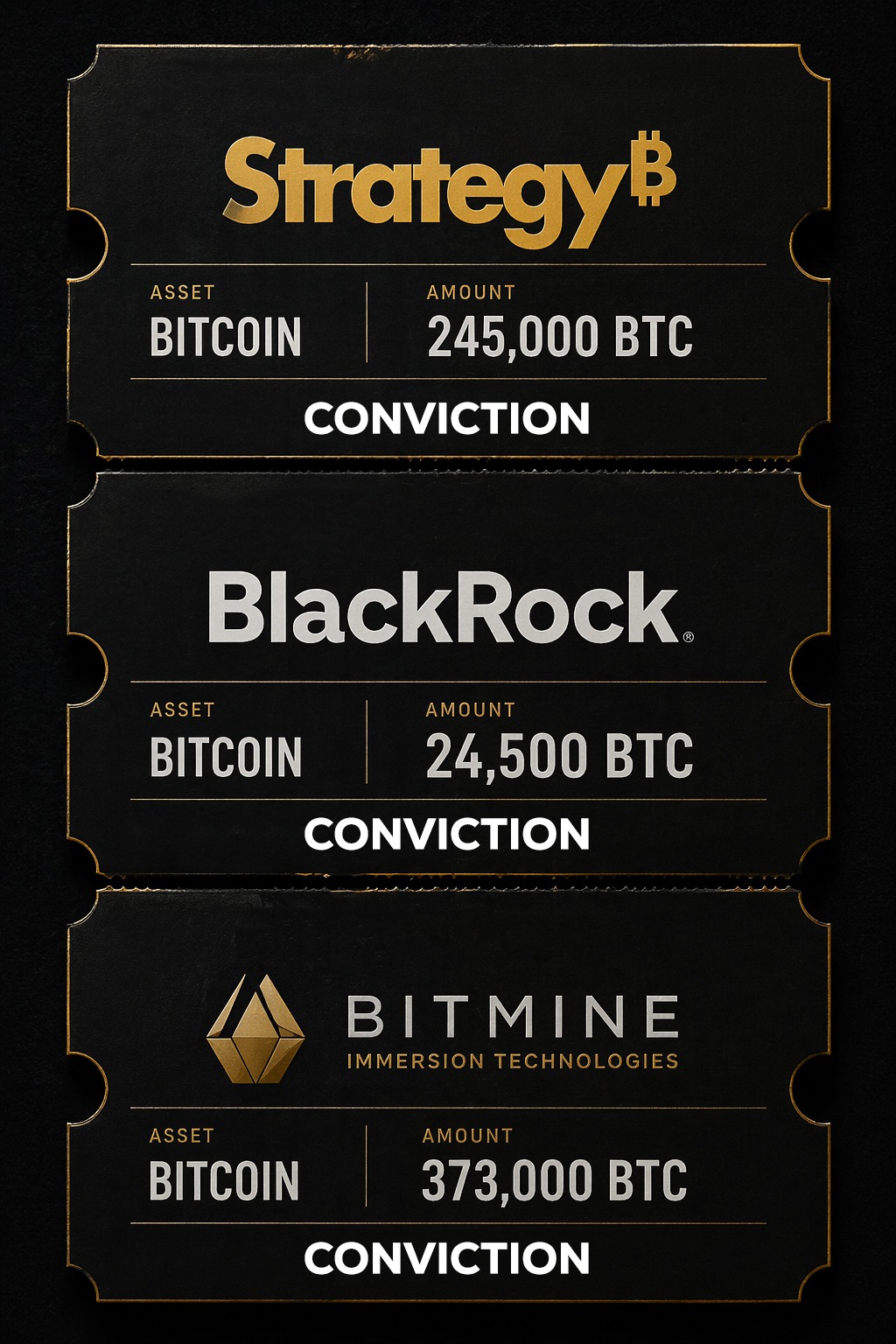
While the regulatory debate drags on in Washington, institutional money has been moving with quiet, deliberate conviction. Strategy made its third-largest Bitcoin purchase on record this week, acquiring 34,164 BTC for US$2.54 billion (AU$3.97 billion), a signal that corporate treasury confidence in Bitcoin hasn't wavered despite the price softening toward US$74,000 (AU$115,500). For a company that has built its entire identity around Bitcoin accumulation, the move is consistent. The scale of it, in the middle of an uncertain macro environment, is worth noting.
BlackRock's spot Bitcoin ETF kept its buying streak intact, adding another US$39.3 million (AU$61.4 million) in BTC this week. It is easy to become desensitised to these numbers appearing in the weekly feed, the consistency matters as much as the size though. Every week that the world's largest asset manager keeps buying through volatility is another week that normalises Bitcoin as a legitimate portfolio allocation at the institutional level.
The most dramatic institutional move of the week belongs to Bitmine. Tom Lee's firm staked an additional 61,232 ETH worth US$142 million (AU$221.8 million), bringing its total staked Ethereum holdings to 3.39 million, valued at US$7.88 billion (AU$12.3 billion) and representing 68% of its entire portfolio. That is not a hedge. That is a conviction bet on Ethereum's long-term value as a yield-generating asset. The message from institutional players this week is consistent: the dip is an opportunity, not a warning.
Crypto Is Becoming the Rails, Not Just the Asset
Three stories this week pointed to the same quiet but significant shift, with crypto moving from something people speculate on to something the financial system actually runs on. The distinction matters, because one is a trade and the other is infrastructure, and infrastructure tends to be stickier, more defensible, and ultimately more valuable.
DoorDash has partnered with Tempo to offer stablecoin payouts to its workers, putting digital dollars directly into the hands of millions of gig economy participants who may never have touched crypto through a traditional exchange. It is the kind of real-world use case the industry has been promising for years, and seeing it arrive through a platform as mainstream as DoorDash is a meaningful signal that stablecoin payments are moving beyond theory. Finally.

Meanwhile, Kalshi and Polymarket are racing to launch crypto perpetual futures, bringing sophisticated financial products to a prediction market audience that sits squarely at the intersection of speculation and information markets. Coinbase also weighed in this week on the quantum computing debate, arguing that crypto's cryptographic foundations remain secure against near-term quantum threats, a conversation that would have seemed premature a few years ago but now reflects an industry thinking seriously about long-term infrastructure risks. These stories don't make headlines the way a price move does. They are the kind of developments that compound quietly and matter enormously over time.
Politics, Lawsuits, and the Ghost of Satoshi
It would not be a complete week in crypto without at least one story sitting somewhere between high drama and genuine concern, and this week delivered several. Tron founder Justin Sun has filed suit against World Liberty Financial, the Trump-backed DeFi project, over WLFI token rights, escalating what was already one of the more politically charged disputes in the space into full legal territory. The lawsuit lands at a sensitive moment, with Trump already fielding fresh insider trading accusations tied to crypto, and the broader question of political entanglement with digital assets becoming harder to ignore. For an industry trying to build credibility with regulators and institutions, the optics of its most high-profile political adjacency ending up in court are not ideal, to put it mildly.
Separately, a trader with a well-documented track record of front-running Trump-adjacent news has reportedly made another significant move this week, keeping speculation running hot on crypto Twitter. No confirmed details yet, the account's history makes it one of the more closely watched wallets in the space though, and we will be monitoring.
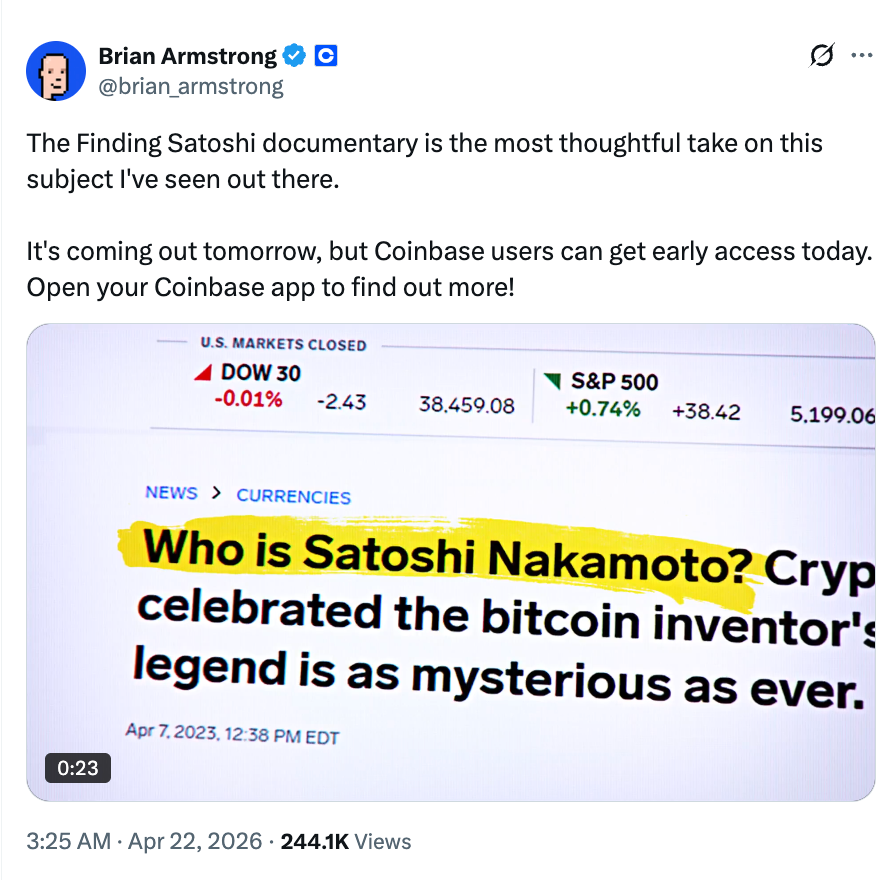
For something altogether more timeless, a new documentary team is actively hunting for the identity of Satoshi Nakamoto, Bitcoin's pseudonymous creator. CoinDesk went inside the effort this week, and while the mystery remains as unresolved as ever seventeen years on, the continued pursuit of it says something interesting about where crypto sits culturally. This is an industry still fascinated by its own origin story, and not entirely sure what it would do with the answer if it found one.
Tim Cook Is Gone And Crypto Should Be Paying Attention
The biggest non-crypto story of the week carries significant crypto implications. Apple CEO Tim Cook has stepped down, closing a carefully managed chapter in which the world's most valuable company kept digital assets firmly at arm's length. Under Cook, Apple was deliberate to the point of cautious, slow on crypto wallet integrations, conservative with the App Store's treatment of DeFi products, and measured in how deeply it allowed fintech partners to push into digital asset territory. That approach reflected Cook's broader operating philosophy: control the ecosystem, manage risk, move deliberately.
His departure opens a genuine question about what comes next. Apple sits on enormous fintech leverage, with hundreds of millions of active devices, a payments infrastructure in Apple Pay that already touches a significant portion of global consumer transactions, and a user base that skews toward exactly the demographic that crypto has been trying to reach for years. The right successor, with the right strategic appetite, could move Apple meaningfully closer to native crypto support, stablecoin integration, or on-device wallet infrastructure in ways that Cook never seemed inclined to pursue.

That is not a guarantee. It is a possibility worth watching closely. In an industry that has spent years looking for the unlock that brings the next hundred million users on-chain, a post-Cook Apple is one of the more genuinely interesting variables on the board. Whoever sits in that chair next will inherit a decision about crypto that Cook largely deferred. They may not defer it the same way.
What's Making Us Laugh This Week


Founder's Corner
This week had a lot of moving parts, but two themes kept surfacing underneath the noise. The first is that institutional conviction is no longer something the industry needs to argue for. It is showing up in the data, week after week, in the form of billion-dollar purchases, ETF inflows, and firms staking the majority of their entire portfolio on a single asset class. That kind of capital doesn't move on sentiment. It moves on infrastructure, compliance, and long-term structural confidence. The second theme is that the political and legal entanglement crypto is navigating right now, the stalled Clarity Act, the WLFI lawsuit, the insider trading accusations swirling around Trump-adjacent projects, is not a distraction from the industry's maturity. It is part of it. Every maturing asset class goes through a period where it gets pulled into the messiness of power, regulation, and competing interests. The ones that come out the other side are the ones built on rails strong enough to survive it.
**All information in this article is for informational purposes only. You should not construe any such information or other material as legal, tax, investment, financial, or other advice. Nothing contained herein shall constitute a solicitation, recommendation, endorsement, or offer by Wayex to invest, buy, or sell any coins, tokens, or other crypto assets. Any descriptions of Wayex products or features are merely for illustrative purposes. Past performance is not a guarantee or predictor of future performance. The value of crypto assets can increase or decrease, and you could lose all or a substantial amount of your purchase price. It is essential for you to do your research and due diligence to make the best possible judgement, as any purchases shall be your sole responsibility.