.png)
This week’s market moves unfolded against a heavy and emotionally charged backdrop, as Australians are due to pause this evening to reflect at memorials honouring the victims of the Bondi Junction tragedy while heading into the Australia Day long weekend.
Against that quieter national moment, global markets delivered anything but calm. Crypto traders woke to sharp volatility driven by macro shocks, shifting political signals, and renewed debates over regulation, governance, and institutional adoption. Bitcoin’s sudden drop and rebound, regulatory infighting in Washington, warning signs in XRP’s on-chain data, and major signals from the NYSE, BlackRock, and Michael Saylor all point to a market caught between short-term uncertainty and long-term structural change. As risk sentiment whipsawed and narratives collided, the past 24 hours served as a reminder that crypto does not move in isolation it reacts to politics, policy, and people, even as it continues to build toward a more integrated role in the global financial system.
What’s Happening On The Wayex Platform
Trump Cancels Tariffs: Market Pumps
Well, what a 24 hours that has been. If you woke up and didn't check your portfolio this morning, BOY, are you in for a surprise. Bitcoin experienced sharp volatility this week, briefly slipping below US$90,000 (AU$133,162) to trade around US$89,900 (AU$133,014) amid a global risk-off move, before rebounding above US$90,100 (AU$133,310) in the following session. The initial sell-off was driven by a collapse in Japan’s government bond market and renewed trade threats from U.S. President Donald Trump against the European Union, which pressured risk assets across the board. During the turmoil of Greenland’s impending invasion and tariffgeddon, Ether underperformed during the downturn, falling more than 7% and dipping below US$3,000 (AU$4,438) for the first time since 2 January, while altcoins broadly saw deeper losses than Bitcoin. As traders de-risked, Bitcoin's dominance climbed to 59.8%, signalling a rotation of capitalback into BTC.
Markets later stabilised after Trump cancelled planned tariffs on Europe, easing macro pressure and lifting sentiment across crypto and equities. According to reporting by Decrypt Bitcoin reclaimed the US$90,000 (AU$133,162) level, while Ethereum rose 2% to US$3,003 (AU$4,439) Solana gained 3.3% to US$131 (AU$191), and XRP climbed 4% to US$1.97 (AU$2.83), pushing total crypto market capitalisation up 1.1% to US$3.14 trillion (AU$2.9 trillion)The rebound followed heavy volatility, with roughly 166,000 leveraged traders liquidated for US$1.01 billion (AU$1.4 billion) over 24 hours.
But could this be a dead-cat bounce? Certainly, some think so, including the team at Coinpedia, which referred to a potential dead cat bounce or while some traders frame the move as a TACO (Trump Always Chickens Out) trade. Reporting from CoinPedia stated that “Bitcoin may have already bottomed, though technical indicators still point to downside risk toward US$80,000 (AU check) before any sustained bullish continuation.
Let’s see what the next 24 hours give us before we make any bull or bear judgments. It’s been a long year (author notes that it’s only January).
Regulatory Clarity Remains Elusive as Crypto Splits Into Camps
The debate over U.S. crypto market structure is intensifying as industry leaders and lawmakers clash over the direction of the proposed CLARITY Act. Cardano founder Charles Hoskinson has emerged as a strong critic, arguing the draft legislation would hand excessive control of the crypto industry to the SEC, classify new projects as securities by default, and ultimately shift power to large banks, undermining crypto’s decentralised vision. He also criticised Ripple CEO Brad Garlinghouse for supporting the bill, rejecting the idea that flawed regulation is better than uncertainty and warning that, once passed, the framework could become as rigid as the Securities Act of 1933. At the same time, industry insiders say the Senate Agriculture Committee’s next draft is expected to include pro-crypto provisions such as shielding developers from liability, but there are concerns it may advance largely along Republican lines, risking insufficient Democratic support to pass the full Senate (CoinDesk).
These tensions escalated after we reported last week that Coinbase withdrew its support for the Senate Banking Committee’s rewritten version of the CLARITY Act, forcing the cancellation of a planned markup and exposing deep divisions within the crypto industry Coinbase said the Senate draft diverged sharply from the House-passed bill, raising concerns over restrictions on tokenised equities, expanded DeFi data reporting requirements, broader SEC authority, and stablecoin provisions that could favour traditional banks and limit competition from crypto-native payment products. The White House and the administration are standing by their bill, with key insiders highlighting that a bad bill is still better than no bill, and a key driving force is the U.S. federal elections, colloquially known as the “Mid-Terms,” coming up in late 2026.
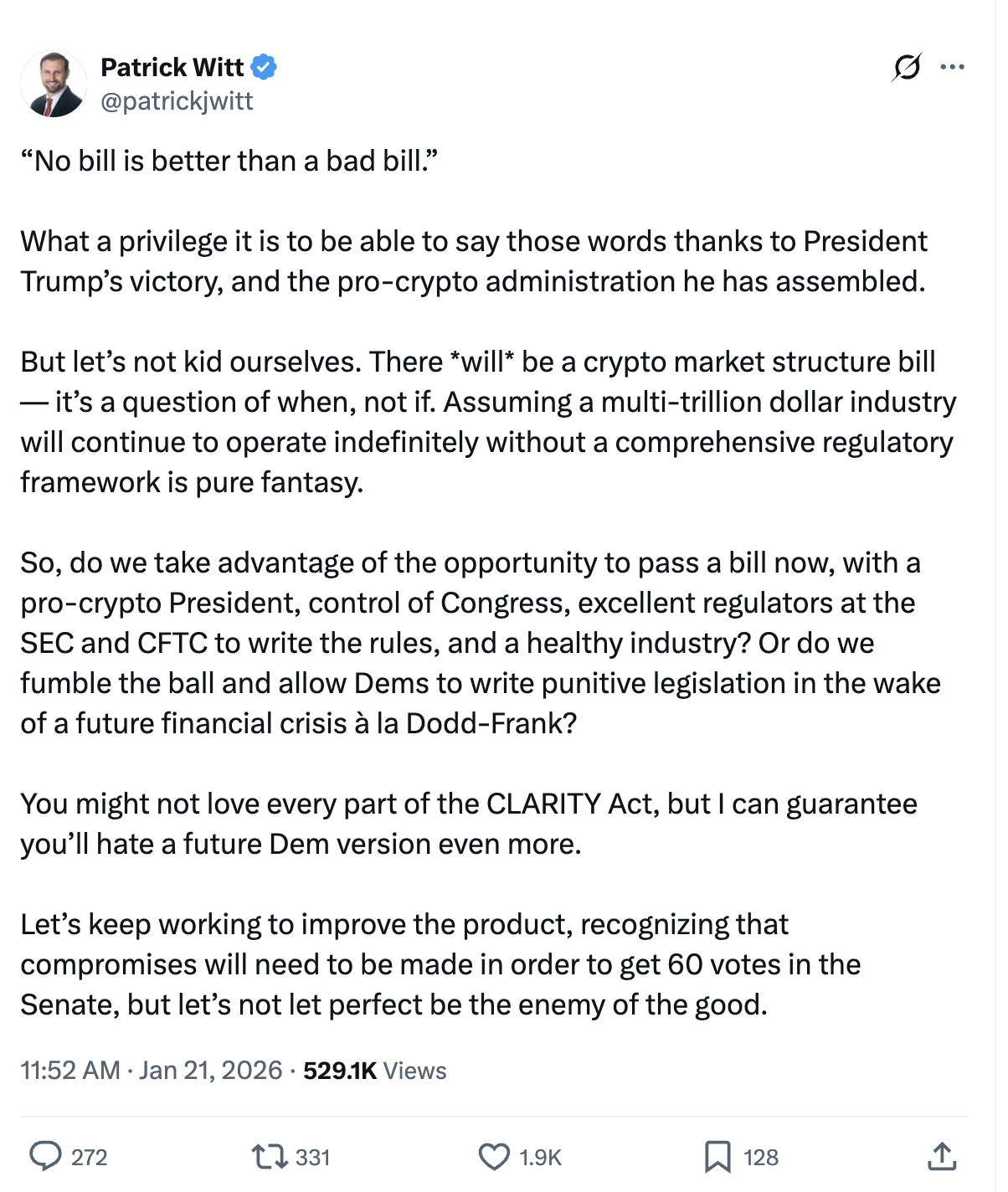
While Senate leaders insist negotiations are ongoing, the new drive is to push the timeline toward a 27th January markup. The episode highlights the fragile balance between bipartisan politics, regulatory clarity, and competing business models, as the U.S. risks falling further behind regions that already operate under unified crypto frameworks.
XRP Price Raises 2022 Comparisons as Volatility Builds
XRP’s on-chain data is beginning to mirror early 2022, a period that was followed by a prolonged price decline, according to Glassnode. The current holder mix shows new buyers from the past one week to one month accumulating XRP at prices below the cost basis of six- to twelve-month holders, creating a split where short-term holders are in profit while many longer-term holders remain underwater. This imbalance can increase selling pressure if price momentum stalls, as seen in February 2022, when XRP traded near US$0.78 (AU$1.09) before falling to US$0.30 (AU$0.42) by mid-year. XRP continues to struggle around the US$2 (AU$2.96) level, which has become a key psychological zone, with each retest since mid-2025 linked to realised losses of roughly US$500 million to US$1.2 billion (AU$737 million to AU$1.7 billion)per week. Glassnode data suggests many longer-term holders use rallies near US$2 (AU$2.95) to exit positions rather than add exposure, leaving XRP caught between fresh short-term demand at lower prices and lingering overhead supply from investors still looking for an exit.
NYSE Moves Toward the Digital Asset Economy
The New York Stock Exchange (NYSE), owned by Intercontinental Exchange (ICE), has unveiled plans to develop a platform for trading and on-chain settlement of tokenised securities, marking a significant step toward digitising core U.S. market infrastructure. Although the plan is subject to regulatory approval, the platform would support 24/7 trading, near-instant settlement, dollar-denominated orders and stablecoin-based funding, while combining NYSE’s existing Pillar matching engine with blockchain-based post-trade systems across multiple blockchains. What could this mean for the digital asset traders like us? It means that tokenised shares would be fungible with traditionally issued securities and carry the same economic and governance rights, including dividends and voting, and would be accessible only to qualified broker-dealers under existing market structure rules. The initiative forms part of ICE’s broader digital asset strategy, including work with banks such as BNY and Citi on tokenised deposits and round-the-clock clearing, and follows reports that ICE has held talks to invest in crypto payments firm MoonPay in a funding round valuing the company at around US$5 billion (AU$7.3 billion).
Vitalik Pushes Back on DAOs and Governance Narratives
Ethereum co-founder Vitalik Buterin has renewed criticism of decentralised governance, arguing that today’s token-based DAO voting has drifted into a “rich rule” system where wealth determines influence rather than participation or expertise. While DAOs were designed to coordinate resources more efficiently than corporations or governments, Buterin says most have devolved into token-voting treasuries plagued by low voter turnout, often below 10%, and growing whale dominance. This “plutocratic” structure, he warns, makes protocols vulnerable to vote-buying, short-term decision-making, and centralisation, undermining the long-term health of crypto systems such as DeFi, stablecoin oracles and on-chain dispute resolution.
Despite these flaws, Buterin maintains that better-designed DAOs remain essential, pushing for governance models that reduce decision fatigue, protect voter privacy, and better align power with real users rather than large token holders. Proposed solutions include quadratic voting, proof-of-humanity systems, zero-knowledge privacy tools, and hybrid approaches like Lido DAO’s dual-governance model, which gives ETH stakers veto power over governance token holders. However, Buterin and industry observers acknowledge trade-offs, warning that more complex governance can slow emergency responses and introduce new privacy risks. Still, the direction is clear: the era of simple token voting is fading, and protocols that fail to evolve risk becoming fragile targets for capture rather than resilient decentralised systems.
Saylor Continues to Accumulate Bitcoin
Michael Saylor’s Strategy has made one of its largest Bitcoin purchases in months, adding 22,305 BTC between January 12 and 18 for US$2.13 billion (AU$3.3 billion) at an average price of US$95,284 (AU$140,422) per coin. The acquisition lifts Strategy’s total holdings to 709,715 BTC, acquired for US$53.9 billion (AU$79.4 billion) at an average cost of US$75,979 (AU check), making it the largest corporate holder of Bitcoin globally. At current prices near US$91,000 (AU$134,124), the treasury is valued at around US$64.6 billion (AU$96.6 billion), leaving the firm with an unrealised gain of more than US$10 billion (AU$14.7 billion). The purchase was funded through equity and preferred stock sales, primarily via MSTR Class A shares and STRC preferred stock, while Strategy still has over US$8.4 billion (AU$12.37 billion) in MSTR stock available for future issuance. Despite the aggressive accumulation, MSTR shares fell nearly 5% over the past week, though the stock remains up more than 12% year-to-date, with institutional investors such as Vanguard and VanEck continuing to increase exposure.
BlackRock Flags Crypto as a Key Market-Driving Theme
BlackRock, the world’s largest asset manager with around US$14 trillion (AU$20 trillion) under management, has named cryptocurrency and tokenisation as major investment themes in its 2026 outlook (source: Brave New Coin). The firm says digital assets are no longer just speculative investments, but are becoming core financial infrastructure that could change how money moves through the global system. Bitcoin, Ethereum and stablecoins were highlighted as key parts of this shift. BlackRock also pointed to the rapid growth of its iShares Bitcoin Trust (IBIT), which passed US$70 billion (AU$103 billion) in assets in just 341 trading days, making it the fastest-growing ETF in history and showing strong demand from institutional investors.
The report also highlighted the growing role of stablecoins, describing them as “digital dollar rails” that allow near-instant settlement and 24/7 payments. The stablecoin market has reached around US$307 billion (AU$452 billion) and could grow to US$500 billion (AU$736 billion) by 2028, supported by clearer regulation, such as the GENIUS Act in the United States. BlackRock also pointed to its BUIDL fund, which has grown beyond US$2 billion (AU$3 billion) and now makes up nearly half of the global tokenised U.S. Treasury market. The firm identified Ethereum as the leading blockchain for tokenised assets, hosting about US$12.5 billion (AU$18.4 billion) in real-world assets, and argued that rising U.S. debt, expected to exceed US$38 trillion (AU$55 trillion), is pushing investors to look beyond traditional hedges and towards digital assets as long-term infrastructure.
Things That Made Us Laugh This Week



Founder's Corner
This week was a reminder that markets don’t move on charts alone; they move on people, politics, and pressure. We saw lurching violently on macro stress, political theatrics, and fragile risk sentiment. Bitcoin’s sharp drop below US$90,000 and rapid rebound weren’t about broken fundamentals; they were about leverage meeting uncertainty. Japan’s bond turmoil, Trump’s tariff threats and abrupt reversal, and the usual scramble for narratives all collided, wiping out over a billion dollars in positions and sending capital rushing back into Bitcoin at the expense of everything else. With the news this morning, we saw over US$850B put back into the market once Trump dropped the threat of these tariffs.
Zooming out, the signal is far clearer than the noise, and it’s uncomfortable for anyone still clinging to old crypto myths. The industry likes to blame regulators, but the truth is that regulatory infighting in the U.S. is just as much a reflection of crypto’s internal fragmentation as it is of politics. DAOs that were supposed to replace institutions are struggling with voter apathy and whale dominance. Assets like XRP are flashing warning signs not because the technology vanished overnight, but because markets eventually force honesty when narratives run ahead of fundamentals. This is what maturation actually looks like: less ideology, more accountability, and fewer free passes for bad design.
At the same time, the so-called “legacy system” is quietly doing what crypto promised, but with discipline. The NYSE isn’t debating whether tokenisation matters; it’s building it. BlackRock isn’t speculating on whether digital assets belong in portfolios; it’s embedding them into market structure. And Michael Saylor’s continued accumulation isn’t blind faith; it’s a long-duration bet that monetary debasement doesn’t fix itself on political timelines. This is the fundamental paradox of the moment: retail markets are trapped in short-term chaos, while institutions are converging on a future that looks unmistakably on-chain. The lesson is simple but hard to swallow: adoption doesn’t arrive with a pump; it comes quietly, structurally, and often while everyone is distracted arguing on X.
Richard Voice, Co-Founder, Wayex
**All information in this article is for informational purposes only. You should not construe any such information or other material as legal, tax, investment, financial, or other advice. Nothing contained herein shall constitute a solicitation, recommendation, endorsement, or offer by Wayex to invest, buy, or sell any coins, tokens, or other crypto assets. Any descriptions of Wayex products or features are merely for illustrative purposes. Past performance is not a guarantee or predictor of future performance. The value of crypto assets can increase or decrease, and you could lose all or a substantial amount of your purchase price. It is essential for you to do your research and due diligence to make the best possible judgement, as any purchases shall be your sole responsibility.