The crypto market has entered a volatile phase after Bitcoin confirmed a “death cross” on 16 November, when its 50-day moving average fell below the 200-day moving average. This came only weeks after Bitcoin hit an all-time high near US$126,000 (AU$191,719), before dropping more than 25% to below US$90,000 (AU$137,901). The fall was driven by a mix of ETF outflows, hawkish signals from the US Federal Reserve and more than US$1 billion (AU$1.5 billion) in liquidations linked to Mt Gox wallet activity. Although sentiment has fallen into “extreme fear”, previous death crosses in recent years have often aligned with market bottoms, leaving analysts divided on whether this signals a deeper downturn or the start of a recovery.
At the same time, the wider industry continues to move forward. New crypto ETFs are launching on Wall Street, AusCryptoCon showcased strong local innovation through this year’s Whale Lab, Klarna announced a new stablecoin, and regulators in Japan and South Korea revealed major reforms to strengthen compliance. Cardano reported its first chain split in eight years, Binance faced a new lawsuit, and Strategy, the largest public holder of Bitcoin, is under pressure following concerns about index exclusion and sharp market declines. Despite the turbulence, builders and institutions remain active, showing that development in the digital asset sector continues even in challenging market conditions.
Winners & Losers on the Wayex Platform
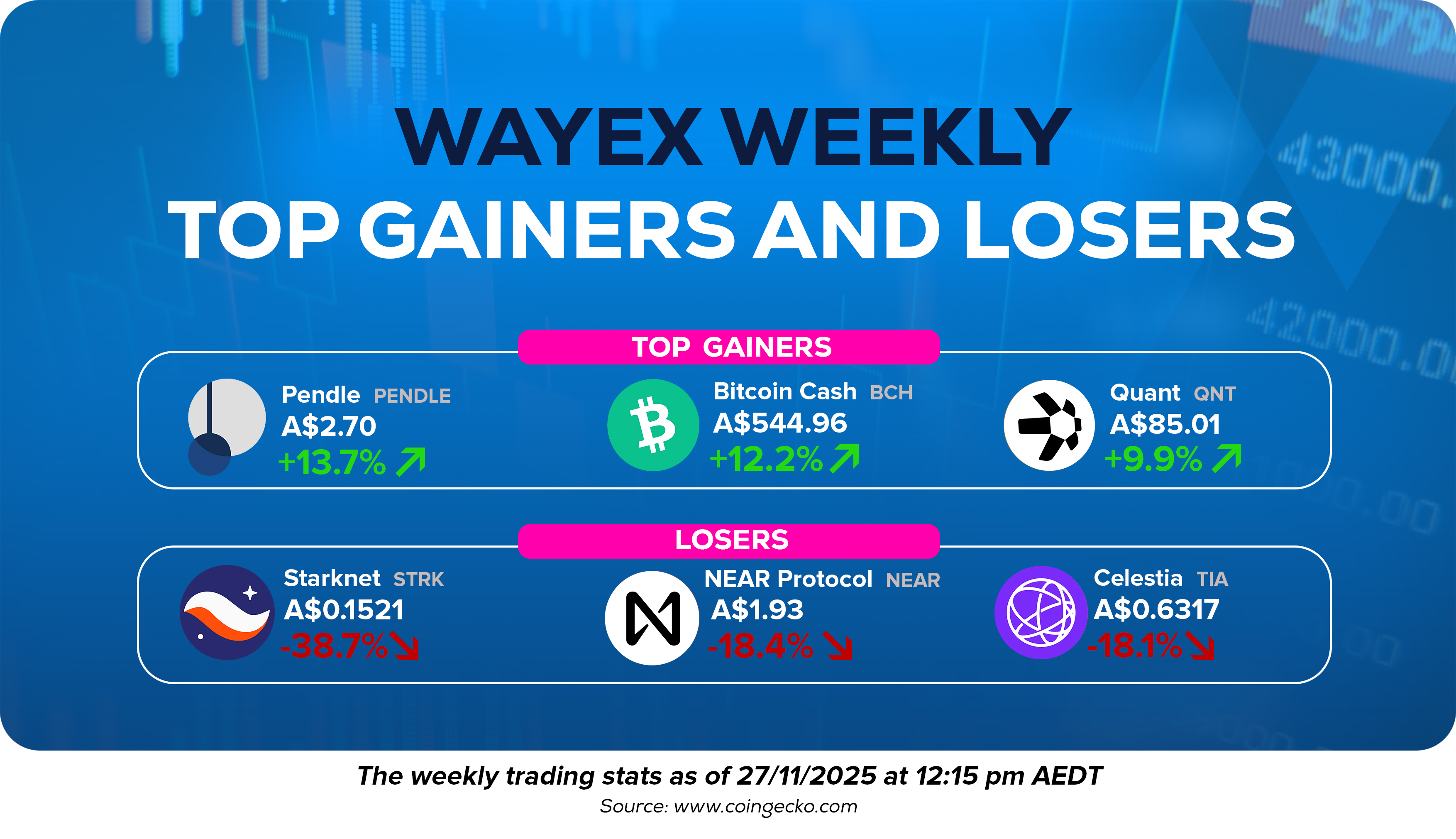
.jpg)
Bitcoin Death Crosses Confirmed Analysts Torn
Investing.com reports that Bitcoin confirmed a “death cross” on 16 November, when its 50-day moving average dipped below the 200-day moving average. This technical signal typically reflects fading momentum, although it often appears after most of the damage has already been done. The crossover occurred just six weeks after Bitcoin reached its all-time high near US$126,000 (AU$193,071), and the asset has since fallen 25% to below US$90,000 (AU$137,901), pushing market sentiment into “extreme fear.” A combination of macro pressures, including a more hawkish Federal Reserve, a stronger U.S. dollar, and weakening expectations for near-term rate cuts, has weighed heavily on Bitcoin. Record outflows from spot Bitcoin ETFs intensified the move, with BlackRock’s IBIT alone seeing US$1.2 billion (AU$1.9 billion) in withdrawals in mid-November. Liquidity also tightened after long-term holders began taking profits following more than 200% gains since 2023, while wallet movements linked to Mt. Gox spooked traders, triggering more than US$1 billion (AU$1.5 billion) in liquidations across 185,000 accounts within 24 hours. Although the backdrop appears bearish, historical data shows that previous death crosses in this cycle in 2023, 2024 and April 2025 aligned with major local lows, and analysts are split on whether this latest setup signals deeper downside or the early stages of a potential rebound.
ETF Spots Debuts On Wall Street
Greyscale recently received approval from the NYSE to launch its spot Dogecoin (DOGE) and XRP exchange-traded funds. Although Greyscale’s XRP ETFs are still pre-launch, DOGE went live. These convert Greyscale's existing trust into ETFs and track each token's spot market price. Although Bloomberg analyst Eric Balchunas anticipated around $11 million (AU$17 million) in volume for Greyscale’s DOGE ETF, it launched with a whimper rather than a bang. CCN reported that the new fund posted zero net inflows on launch day and generated just US$1.4 million (AU$2.1 million), missing first-day volume expectations. It's a big miss from XRP's spot ETF launched by Bitwise (XRP ETF) and Canary Capital (XRPC ETF). Last week, Canary Capital's November 17th 2025 launch received US$59 million (AU$90 million) on the first day of trading. Bitwise celebrated the launch of its spot XRP ETF this week. The Crypto Basic reported receiving US$135 million (AU$206 million) in ETF flows in the first three days of the fund.
Bitwise has received approval from the NYSE to launch its own DOGE ETF, under the BWOW ticket, launching November 26th EST. We’ll have to see how their debut compares to Greyscales.

AusCryptoCon Reporting Back From The Fun Times
AusCryptoCon last weekend was incredible and a clear reminder of how far this space has come. We were thrilled to present this year’s Whale Lab, giving Web3 innovators a chance to compete for $1 million in VC funding and pitch their vision to some of Australia’s leading Web3 investors. A huge congratulations to this year’s winner, Adaluma. We can’t wait to see everyone again at AusCryptoCon 2026!

Klarna Launches A Stablecoin
Klarna has made its first significant move into digital assets with the launch of KlarnaUSD, a U.S. dollar–pegged stablecoin built on Tempo, the blockchain co-developed by Stripe and Paradigm.

Currently live on testnet and expected to debut on Tempo’s mainnet in 2026, KlarnaUSD is issued through Stripe’s Bridge Open Issuance platform and is designed to reduce the cost of cross-border payments significantly. This market generates roughly US$120 billion (AU$183 billion) in annual fees. With 114 million users and US$112 billion (AU$171 billion) in yearly gross merchandise volume, Klarna believes it has the scale to reshape global payments while also diversifying beyond its BNPL core. If widely adopted, KlarnaUSD could meaningfully cut operational costs, improve cash flow, and open new revenue streams at a time when stablecoin settlement volume already exceeds US$27 trillion (AU$41 trillion) annually. Klarna’s move follows PayPal’s rollout of its Ethereum-based PYUSD and positions the company more competitively against rivals like Affirm, which forecasts more than US$47.5 billion (AU$72.7 billion) in GMV for fiscal 2026.
Japanese, South Korean Regulators Come Out Swinging
Japan and South Korea are both moving to strengthen oversight of their crypto sectors, introducing major policy reforms focused on customer protection, financial stability and tighter compliance. In Japan, the Financial Services Agency plans to submit legislation in 2026 requiring exchanges to maintain reserve funds for customer compensation, modelled on the reserve requirements used by securities firms, which range from ¥2 billion to ¥40 billion (AU$19 million to AU$392 million). Japan’s plan is part of a larger regulatory overhaul that adds stricter asset segregation requirements, new rules for third-party custodians, and the possible reclassification of crypto assets under the Financial Instruments and Exchange Act.
South Korea is also tightening oversight following a year-long series of inspections focused on KYC and AML obligations. The Financial Intelligence Unit is preparing sanctions against Bithumb, Coinone, Korbit and GOPAX, similar to the penalties imposed on Upbit operator Dunamu, which was fined $35.2 billion KRW (AU$36 million) and temporarily barred from onboarding new users. At the same time, the Bank of Korea has issued a detailed warning against allowing nonbank companies to issue won-based stablecoins, arguing that doing so would resemble narrow banking and could weaken financial and foreign exchange stability. The central bank believes banks are best positioned to take majority stakes in stablecoin issuers due to their regulatory oversight and AML expertise. Still, industry leaders argue this model could stifle innovation. The unresolved debate has left many companies uncertain about ownership rules, issuance caps and the approval process, signalling that regulatory direction may remain unsettled into early 2026.
Cardano Calls The FBI
Cardano suffered its first major chain split in eight years on November 21 after a flawed delegation transaction exposed a vulnerability in one of its network software libraries, briefly resulting in two competing versions of the blockchain. The incident, which mirrored a similar issue seen the day before on the preview testnet, prompted an urgent multi-team response from Input Output, the Cardano Foundation, Intersect, and other contributors. Exchanges including Coinbase, Upbit and Kraken temporarily paused deposits and withdrawals while validating chain integrity, with Coinbase maintaining the longest halt at roughly 14 hours. The individual responsible, known as “Homer J,” admitted the error stemmed from an attempt to replicate a previous transaction using untested AI-generated instructions and stressed that there was no malicious intent. Cardano founder Charles Hoskinson confirmed that the matter had been reported to authorities, including the FBI, and that the situation led at least one developer to resign due to concerns about potential legal liability for future mistakes.
Binance Sued Again, Pardon Questioned For CZ
Dozens of families of victims of the Oct. 7, 2023, attacks in Israel have sued Binance in U.S. District Court in North Dakota, alleging the exchange knowingly facilitated more than $50 million (AU$76 million) in transactions for Hamas, the Islamic Revolutionary Guard Corps of Iran, Hezbollah and Palestinian Islamic Jihad since the attacks. The lawsuit comes one month after President Donald Trump pardoned Binance founder Changpeng Zhao, who had pleaded guilty to failing to combat money laundering and later served a four-month jail sentence before his release in September 2024. The complaint argues that Zhao and associate Guangying “Heina” Chen operated Binance as a criminal enterprise that allowed terrorist groups to transact freely, even as Hamas publicly directed donors to send funds to Binance wallets. Plaintiffs, who are U.S. nationals and their close family members, are seeking compensatory and treble damages under federal anti-terrorism laws.
The suit also cites earlier federal investigations that led to Binance paying more than $4.3 billion in penalties in late 2023 and the Treasury Department finding that the company failed to file required Suspicious Activity Reports on significant sums tied to terrorist organisations. Binance declined to comment but said it complies with sanctions laws and has overhauled its compliance systems in recent years.
Michael Saylor All In On Bitcoin: Is It A Mistake?
Strategy, formerly known as MicroStrategy and the largest public holder of Bitcoin, is facing mounting pressure after JPMorgan warned that the company may soon be removed from major equity indices, including the MSCI USA Index. Bitcoin has fallen more than 30% from its all-time high and is now trading around US$90,485 (AU$139,156.99) as of 11:50 am AEST. In comparison, the broader crypto market has lost approximately $1 trillion in market capitalisation (AU$1.5 trillion) over the past month. Strategy’s stock has plunged, and JPMorgan’s analysts noted that the company’s heavy reliance on Bitcoin puts it at risk as MSCI reevaluates whether firms with more than 50% of their assets in digital currencies should remain in traditional equity benchmarks. They estimate that a potential exclusion could trigger US$2.8 billion (AU$4.2 billion) in outflows, with total outflows possibly reaching US$8.8 billion (AU$13.4 billion) if other index providers follow MSCI’s lead.
The situation has been intensified by rumours that JPMorgan is holding a large short position against Strategy, along with reports of widespread account closures from customers who claim the bank is manipulating both MSTR and Bitcoin. We, at Wayex, would like to reiterate that not all rumours on the internet are true… So take it with a grain of salt. However, CryptoRank.Io reported that share lending for MSTR has increased, making it easier for short sellers to pressure the stock, while concerns of a short squeeze continue to grow. Amid the volatility, Strategy CEO Michael Saylor has pushed back, emphasising that the company remains a software business with an active financial strategy rather than a passive Bitcoin holder. It is also actively diversifying its crypto custodians, moving approximately 59,380 Bitcoin from Coinbase to Fidelity Custody over the last two months. With Morgan Stanley’s Capital International decision on January 15 approaching, market sentiment remains fragile, and the fallout from JPMorgan’s timing and commentary continues to shape the narrative.
Things That Made Us Laugh This Week



Founder's Corner
What a week. ETFs saw heavy outflows, and everyone is arguing whether this is the start of a deeper drop or the kind of shakeout that usually marks a bottom. Classic crypto chaos, however, nothing we haven’t survived before.
But while traders panic, the industry keeps moving. New ETFs are launching on Wall Street, AusCryptoCon showcased incredible local innovation (huge congrats to Adaluma for winning this year’s Whale Lab), and it was fantastic to MC the whole Whale Lab event. Klarna announced its own stablecoin, and regulators in Japan and South Korea are rolling out real frameworks. Even with Cardano’s chain split, Binance’s legal drama and pressure on Saylor’s Strategy, one thing is clear: the builders aren’t slowing down.
Volatility comes and goes, but progress keeps compounding. Zoom out, stay steady, the long game in the past has always had the upside.
Richard Voice, Co-Founder, Wayex
**All information in this article is for informational purposes only. You should not construe any such information or other material as legal, tax, investment, financial, or other advice. Nothing contained herein shall constitute a solicitation, recommendation, endorsement, or offer by Wayex to invest, buy, or sell any coins, tokens, or other crypto assets. Any descriptions of Wayex products or features are merely for illustrative purposes. Past performance is not a guarantee or predictor of future performance. The value of crypto assets can increase or decrease, and you could lose all or a substantial amount of your purchase price. It is essential for you to do your research and due diligence to make the best possible judgement, as any purchases shall be your sole responsibility.