.png)
This week in crypto feels like a perfect snapshot of where the market is right now: reactive, fragmented, and still trying to find its footing. A short-lived relief rally driven by geopolitical headlines quickly gave way to renewed uncertainty, while beneath the surface, larger structural shifts are taking shape across regulation, institutional adoption, and risk management in a maturing industry. From governance failures and protocol shake-ups to stablecoins pushing toward mainstream payments and traditional finance stepping further on-chain, the signal is getting clearer, even if the noise is louder than ever.
What’s Happening On The Wayex Platform
.png)
.png)
Well, That Was A Nice 12-hour Break - Geopolitical Madness And BTC Pricing
A fresh wave of geopolitical uncertainty is now testing Bitcoin’s rally as tensions in the Middle East escalate again following Israeli strikes in Lebanon and Iran, signalling potential retaliation. What initially drove a relief rally, the U.S.-Iran ceasefire and over US$425 million (AU$604 million) in short liquidations, is now being challenged by renewed conflict risk, including disruptions around the Strait of Hormuz and reported attacks across the Gulf.
This shift reinforces the broader theme already playing out in the market: short-term moves are being driven by headlines, not fundamentals. The brief rally lifted the crypto market capitalisation to US$2.5 billion (AU3.5 billion), but whether this holds given the ceasefire's tentative nature remains to be seen. With uncertainty returning, declining spot volumes, cautious U.S. sentiment, and "smart money" positioning defensively, the risk of volatility remains elevated. Until there is a clearer, sustained resolution rather than temporary ceasefires or conflicting signals, any upside is likely to remain fragile and reactive, not the start of a stable, long-term trend.
Bitcoin briefly pushed above US$72,000 (AU$102,393) after a ceasefire-triggered rally and US$280 million (AU$398 million) in short liquidations, but the move appears fragile as bearish positioning remains largely intact. With weak derivatives demand and ongoing macro uncertainty, analysts suggest the upside may be limited in the near term, with CoinTelegraph's potential pullback toward US$68,000 (AU$96,709) still in play.
Adding to the pricing uncertainty is that Bitcoin and Solana jumped after reports that Iran may require crypto payments for oil transit, showing how quickly geopolitics can move markets, even as uncertainty remains.
Whatever happens, we’ll still be here.
New York Times “Uncovers” Satoshi
The New York Times famed business reporter, John Carryrou, an investigative journalist who wrote a book exposing the “Theranos” fraud, has focused his attention on
Identifying the long elusive founder of Bitcoin, Satoshi Nakamoto.
Now, it is important to note that Adam Black has long been one of the prime suspects in the case of Satoshi Nakamoto. Over the years, many names have come up as possible "Satoshi", including Elon Musk, Gavin Andresen, Jeffrey Epstein, and Adam Black, who has long been suspected.
Carryrou was spurred on to do this investigative reporting by a Canadian documentary that identified the true founder as an unnamed Canadian programmer. The New York Times article layed out its evidence in detail with the key evidence against Black being the following: Black fit the biographical profile, being an expert in cryptography and the disturbed computing concept; Black was "cagey" when asked about being Satoshi; he gave unconvincing answers to the denial; similar writing ticks to Satoshi's and similar anarchist ideals that Satoshi and the movement itself spouted.
Although we agree with crypto Twitter that the evidence is, at best, flimsy, we like everything, encourage you to DYOR. The article is interesting and goes into great detail about the birth of Bitcoin and the CyberPunk mailing list. It details the close relationship between the two around the founding of the BTC protocol.
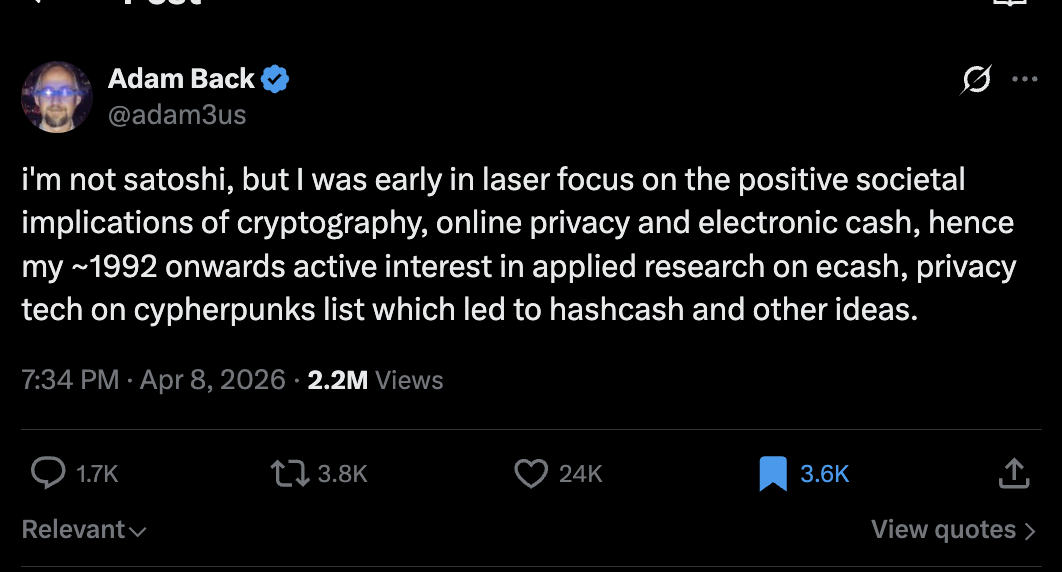
But for the sake of transparency, here is Adam Black's denial and a great reminder that not everything on the internet is true (just in case you need it).
Drift And Aave Labs Drama: The Analysis
We briefly touched on this last week, and not to keep banging the drum, I wanted to talk about it because it was so absolutely wild to me. Unfortunately, the Drift Protocol exploit highlights a major shift in DeFi risk, with attackers stealing around US$280M–US$285M (AU$398 million - AU$405 million) not through a smart contract bug, but by compromising governance and multisig approvals to execute seemingly legitimate transactions. The attack relied on long-term social engineering and fostered connections with the Drift team over months, built at conferences and tech events. The manipulation of trusted signers and the use of delayed execution tools to bypass detection show that control over access and processes is now a greater vulnerability than code itself. The hack shows that two things are important in the next stage of building in our industry. One: as DeFi matures, security must evolve beyond technical fixes and focus just as heavily on Governance, permissions, and human-layer risks
The recurring theme here is that Governance is hugely important in the next wave of crypto adoption, with another important event being the Chaos Labs' exit from Aave. After more than three years managing risk, the firm is stepping away due to a fundamental misalignment with Aave Labs on how risk should be prioritised and resourced, particularly as V4 introduces a more complex architecture and significantly expands operational demands.
Despite helping scale Aave from $5.2 billion (AU$7.4 billion) to over $26 billion (AU$37 billion) in Total Value Locked (TVL) with zero material bad debt, Chaos Labs flagged concerns about increased workload, under-resourcing, and the need to manage both V3 and V4 simultaneously. Their departure, alongside that of other key contributors, signals a broader shift within the ecosystem and raises questions about continuity, security, and Governance as Aave enters its next phase.
As crypto scales to the next 100 million users, Governance will be a key theme in the next phase of adoption.
Altcoins Are Having A Good Week, But Altseason Hype Falls
Mantra [Old] OM, as of 11 am (AEST), had a 7-day increase of 321.5%, a far cry from its position last year amid allegations of insider dumping. But Mantra, a clear outlier this week as Altcoin Season (again), fails to live up to the hype.
Although some in the community say Altcoins are starting to flash early signs of a potential breakout, analysts are pointing to technical patterns that echo the 2020 rally setup. Mark Chadwick, cited in CryptoNews.Net, highlighted a multi-year falling wedge breakout on the TOTAL2 chart alongside a possible bullish MACD crossover, suggesting a shift in momentum. Meanwhile, Crypto Patel noted that altcoins are bouncing off a long-term trendline, signalling that a potential bottom may already be in place.
However, not all analysts are calling a full cycle just yet. Ash Crypto noted improving momentum but cautioned that key factors, such as Bitcoin dominance and overall liquidity, still need to align before a sustained altcoin rally can take hold.
Altcoin fans need to hold on. Although the CMC index is higher than it has been, with last week's ranking this year's highest, it's still not enough to move the market.
We have been lied to before, so let's hold steady.
Crypto Scams Surge: Protecting Yourself In Any Market
Crypto fraud is scaling fast, and the latest data from the Federal Bureau of Investigation shows just how serious it’s getting, with losses surpassing US$11 billion (AU$15.95 billion) in 2025 and rising 22% year-on-year. Investment scams continue to dominate, often built on long-term psychological manipulation that draws victims into committing large sums, with average losses exceeding US$62,000 (AU$90,776) and nearly 18,600 individuals losing more than US$100,000 (AU$142,000) each. What’s more concerning is the growing sophistication of these schemes, from AI-driven impersonation to organised criminal networks operating at scale, often linked to operations in Southeast Asia. As crypto adoption expands, so does the threat landscape, reinforcing the need for stronger education, smarter safeguards, and infrastructure that prioritises security alongside access.
In the age of deepfakes, AI slop, and misinformation, protecting yourself from scams is more important than ever. The most common scams still follow familiar patterns: investment scams promising high returns with low entry, often backed by fake websites or celebrity endorsements; recovery scams targeting previous victims with false promises of getting funds back; impersonation scams where attackers pose as exchanges, banks, or service providers to access your accounts; romance or friendship scams that build emotional trust before introducing fake investment opportunities; and job scams that trick users into setting up accounts or wallets, unknowingly involving them in money laundering. The red flags are usually the same: pressure to act quickly, guaranteed returns, requests for upfront payments, or anyone asking for sensitive information. If you're seeing those signals, it's time to walk away.
And if you are ever concerned about your transaction with Wayex, our Customer Service Team is available 24/7, and we will always use official channels to communicate with you.
Stablecoins Volumes Could Hit 1.5 Trillion By 2035
Chainalysis has made a bold call on the future of stablecoins, forecasting that annual transaction volumes could reach US$1.5 quadrillion by 2035, up from an estimated US$28 trillion in 2025. The projection is driven by two major forces: a massive US$100 trillion generational wealth transfer into more crypto-native investors, and the expansion of stablecoins into everyday payments, potentially putting them on par with traditional giants like Visa and Mastercard. The trend is already playing out in real time, with six Swiss banks, including UBS, launching a sandbox to test a Swiss franc-pegged stablecoin and explore how blockchain can integrate with traditional currency systems. However, the outlook still comes with significant caveats, as the forecast relies on aggressive assumptions about sustained growth, merchant adoption, and shifting consumer behaviour, all of which face real-world constraints such as regulation and entrenched payment networks.
However, the outlook comes with significant caveats. The forecast relies on aggressive assumptions about sustained hyper-growth, widespread merchant adoption, and a shift in consumer behaviour toward stablecoin payments, all of which face real-world constraints, including regulation, entrenched payment networks, and user habits. The takeaway is clear: while the direction of travel for stablecoins is strong, the scale and speed of that transformation remain far from guaranteed.
Mergers, Acquisitions, Governance, Oh Yeah
Coinbase’s move into Australia with a full Australian Financial Services Licence (AFSL) signals a major step toward blending crypto and traditional finance, enabling a single regulated platform offering crypto, equities, and derivatives while unlocking partnerships with banks and pension funds. At the same time, global regulators are tightening their grip, with the U.S. Treasury proposing rules under the GENIUS Act that would treat stablecoin issuers like traditional financial institutions, requiring strict AML controls, sanctions compliance, and the ability to freeze or block transactions when needed, while South Korea’s proposed Digital Asset Basic Act introduces similar bank-style oversight for stablecoins and broader market regulation.
This shift is being mirrored by traditional finance, with Standard Chartered reportedly moving to integrate its crypto custody arm, Zodia Custody, directly into its core banking division, signalling that digital assets are no longer being treated as experimental but as core financial infrastructure. Together, these developments point to a clear direction: crypto is being drawn into the regulated financial system at every level, with future growth defined by compliance, institutional integration, and infrastructure increasingly mirroring traditional finance.
Things That Made Us Laugh This Week


Founder's Corner
This week was a reminder that crypto is still a headline-driven market, but the real story sits in the infrastructure being built between those moments. The Drift Protocol exploit showed that risk is shifting beyond code to governance, access, and the human layer, something that will only matter more as the industry scales to its next hundred million users. At the same time, moves like Coinbase securing an AFSL in Australia signal that regulated, infrastructure-grade crypto is no longer theoretical; it's being built in real time. The takeaway is clear: the future of crypto will be defined less by short-term price moves and more by the strength of its rails, compliance, and systems that can support real-world use at scale. The industry-regulated, infrastructure-grade crypto is no longer a future state; it's being built right now. At Wayex, that's the exact space we're operating in: real payments, real rails, real compliance. The noise on crypto Twitter this week, Satoshi conspiracies, April Fools hangovers, and altseason false starts, is entertaining. Still, the signal underneath it all is that this industry is growing up. We're here for that version of it.
**All information in this article is for informational purposes only. You should not construe any such information or other material as legal, tax, investment, financial, or other advice. Nothing contained herein shall constitute a solicitation, recommendation, endorsement, or offer by Wayex to invest, buy, or sell any coins, tokens, or other crypto assets. Any descriptions of Wayex products or features are merely for illustrative purposes. Past performance is not a guarantee or predictor of future performance. The value of crypto assets can increase or decrease, and you could lose all or a substantial amount of your purchase price. It is essential for you to do your research and due diligence to make the best possible judgement, as any purchases shall be your sole responsibility.