.png)
This week highlighted the growing disconnect between macro markets and crypto: gold and silver surged as the U.S. dollar slipped. At the same time, Bitcoin remained rangebound amid limited guidance from Fed Chair Jerome Powell. Regulatory pressure also intensified, with ASIC warning crypto firms about operating in grey areas and reinforcing that stance through a high-profile enforcement case, as scam activity rebounded to a record US$158 billion (AU$224 billion) in 2025 according to TRM. Market sentiment remains fragile following the October 10 flash crash, which wiped out more than US$19 billion (AU$27 billion) in leveraged positions, reigniting debate over infrastructure risk, exchange reliability, and whether Binance played a role. The exchange has strongly denied the claim while confirming that user compensation will be provided. Structurally, Bitcoin is cooling rather than breaking, holding above key long-term levels despite ETF outflows, corporate shutdowns, and GameStop's US$420M (AU$597 million) BTC transfer to Coinbase Prime, sparking fresh sell-side speculation. Against this backdrop, selective pockets of strength are emerging, including renewed whale accumulation in privacy coins like Zcash and a growing push toward real-world asset tokenisation, as firms search for sustainable models beyond pure price exposure.
What’s Happening On The Wayex Platform This Week
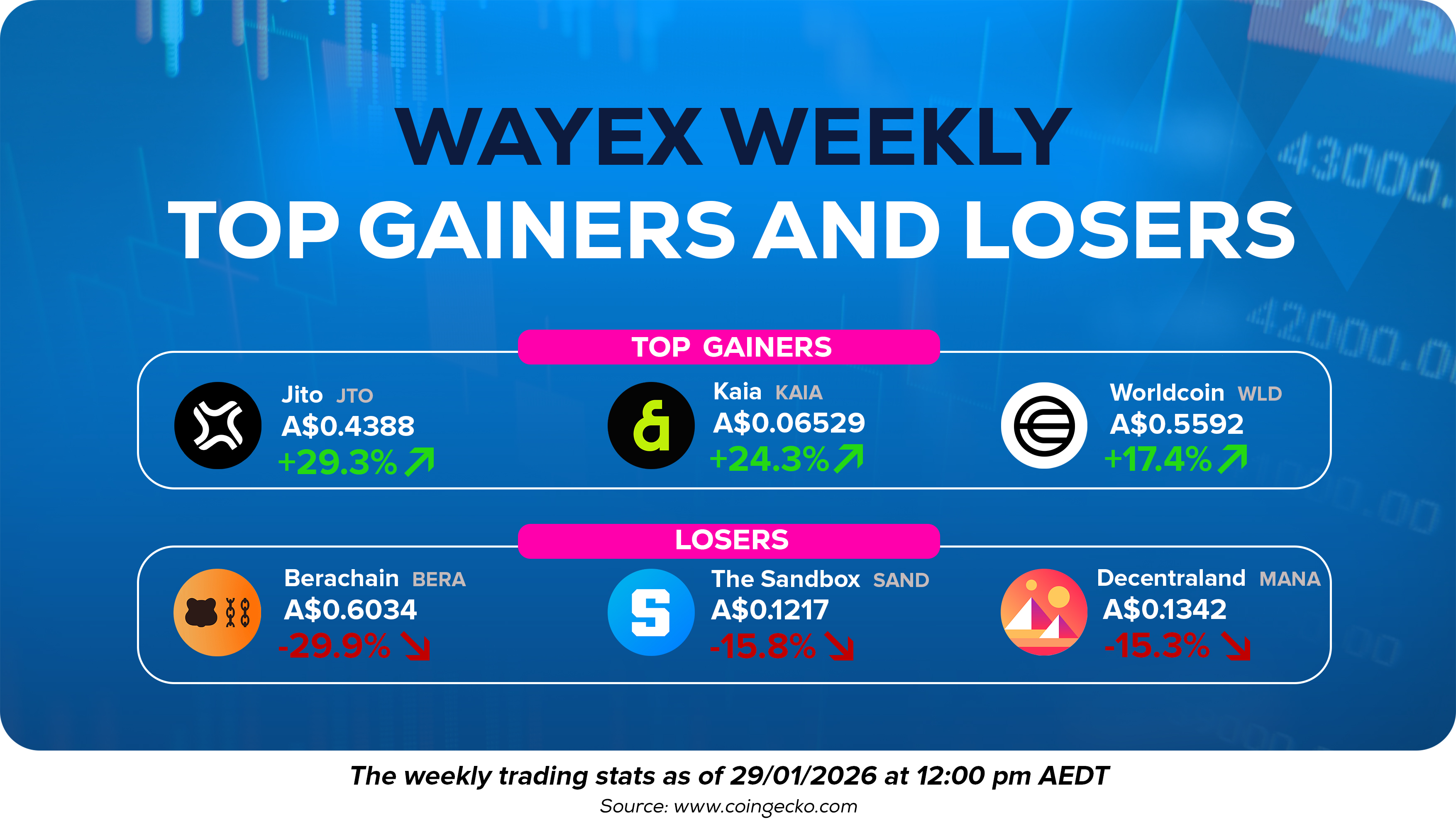
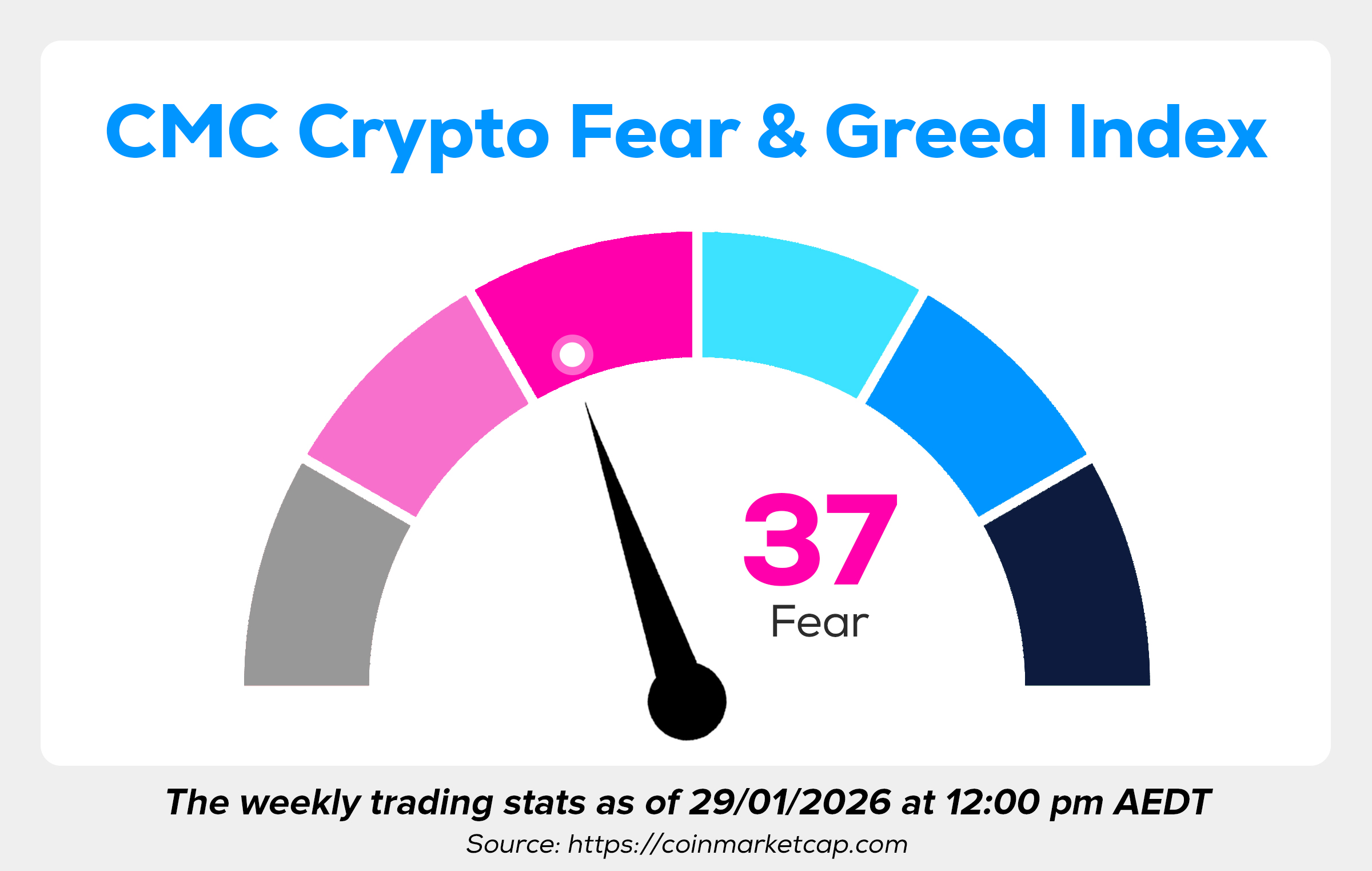
Gold Rallies, Dollar Slips, Crypto Cools As Powell Offers Little New Insight
Bitcoin remained quiet this week while gold and silver surged to new records. The rallies in the mineral were sharply contrasted by a slowdown in crypto’s pricing movements, which was felt by “safe assets” like Bitcoin.
According to CoinDesk, the move followed comments from U.S. Federal Reserve Chair Jerome Powell, who offered little new guidance on interest rates. With no clear signal from the Fed, markets stayed cautious, leaving Bitcoin trading sideways as investors weighed inflation risks and broader economic uncertainty.
However, the declining dollar is an intentional economic policy of the Trump administration. In one of my absolute fav crypto newsletters, "Crypto Is Macro Now" by Noelle AchesonAcheson, writes that "the weaker dollar follows renewed attention on President Trump's push to address what he sees as long-term dollar overvaluation, with policy aimed at supporting US manufacturing and trade". While the falling dollar and surging gold prices point to a shift away from traditional reserve assets, Bitcoin has yet to respond meaningfully, trading sideways.
The gap between gold’s rally and Bitcoin’s flat price action highlights how investors are leaning towards defensive assets right now. Indeed, Bitmine’s Tom Lee was quoted as saying that the rallies had “sucked the oxygen out of crypto”.While Bitcoin is often compared to digital gold, this period shows that traditional markets still attract stronger demand during times of uncertainty. Even so, the lack of heavy selling (thus far) suggests crypto markets remain steady, with traders waiting for clearer direction from central banks before making bigger moves.
ASIC Puts Crypto Firms On Notice Over Compliance Standards
Australia’s corporate regulator, ASIC, has warned that rapid innovation across digital assets, payments and artificial intelligence is creating regulatory gaps that could put consumers at risk. In its Key Issues Outlook 2026 report, ASIC said the fast growth of unlicensed crypto and fintech firms has outpaced existing rules, leaving uncertainty around how new products should be regulated. While the regulator noted that it is up to the government to decide whether emerging digital asset services fall under current frameworks, it raised concerns that some firms may deliberately operate in grey areas to avoid licensing, thereby increasing the risk for everyday investors.
Those warnings have been reinforced by a recent Australian federal court ruling against crypto firm BPS Financial, which was fined AU$9.3 million for misleading investors about its Qoin token. The court found BPS falsely claimed Qoin could be exchanged for cash or other crypto, suggested its wallet had government approval, and overstated merchant adoption, while also rejecting the firm’s attempt to rely on another company’s licence. Most penalties for misleading marketing have now been abolished, and BPS has been banned from offering unlicensed financial services for 10 years. ASIC said the case sends a clear message that crypto firms will be held to the same standards as other financial services, particularly when marketing products to retail investors.
Scams Are Back In A Big Way, Always Be Aware
Unfortunately, TRM (a Blockchain Investigation and Risk Management Firm) is reporting that crypto scams have increased for the first time in 3 years. TRM’s newly released 2026 Crypto Crime Report shows illicit crypto activity rebounded in 2025, reaching a record US$158B (AU$225 billion) in incoming value to illegal entities. The rise was driven by sanctions designations, nation-state use of crypto rails, and improved attribution that surfaced previously unattributed activity. Even so, illicit activity as a share of total attributed on-chain volume fell from 1.3% in 2024 to 1.2% in 2025, while a new liquidity-based measure shows illicit entities captured 2.7% of incoming VASP liquidity, down from 2.9% in 2024 and 6.0% in 2023. The report also highlights key risk areas, including Russia-linked sanctions flows tied to the ruble-pegged stablecoin A7A5, US$2.87 billion (AU$4.08 billion) stolen across nearly 150 hacks, led by the US$1.46B (AU$2.07 billion) Bybit breach, and roughly US$35 billion (AU$50 billion) sent to fraud schemes, with stablecoins accounting for 84% of verified fraud inflows.
CZ Pushes Back And Draws On Claims Of Coordinated Attacks
Crypto’s loudest voices have come out swinging this week, ushering in one of my favourite phases of the market: public Twitter beefs. For those not chronically online like myself, the current dispute centres on the “who, what and where” of the October 10 crash, one of the most severe flash crashes in crypto history. The sell-off followed a tariff threat from U.S. President Donald Trump, which triggered a sharp global risk-off move and wiped out more than US$19B (AU$27 billion) in leveraged crypto positions in a single day. Speaking later on Fox Business, ARK Invest CEO Cathie Wood estimated total system losses closer to US$28B (AU$40 billion) as forced deleveraging spread through the market, with Bitcoin absorbing much of the selling pressure due to its deep liquidity.
Wood linked the crash to a software glitch at Binance, a claim the exchange strongly denied, saying the sell-off was driven by broader market conditions rather than platform failure. Binance said its core systems remained operational and that it paid around US$283M (AU$402 million) in compensation related to de-pegging and technical issues, adding that the most severe glitches occurred after the market had already bottomed. While Wood believes the worst of the deleveraging is now behind us, she said infrastructure reliability remains a key concern for institutional investors as they assess Bitcoin’s position in its four-year market cycle. Once the comments hit Crypto Twitter, the debate escalated quickly, with OKX CEO Star Xu weighing in and Binance founder Changpeng Zhao pushing back, calling the claims a coordinated attack and pointing to similar language being used across posts as evidence of possible coordination.

We'll have to see who wins this fight. Whether it was a coordinated attack or not, it is essential to note that Binance has provided compensation to affected users.
Who's right, who's wrong? I can't say right now. But it is remiss of us not to remind people that both things can be true, that this Twitter pile-on may be coordinated, and Binance's software glitch could have triggered a massive liquidation event.
Ethereum Treasury Company Doubles Down on Real-World Asset Tokenisation
Ethereum-focused treasury firm ETHZilla has taken an unconventional step by adding jet engines to its balance sheet, purchasing two CFM56 aircraft engines for US$12.2M (AU$17.3 million) through a newly formed aerospace subsidiary. According to CoinDesk, the engines are leased to a major airline and managed by a specialist operator, generating income through standard aerospace leasing arrangements. The move follows ETHZilla’s earlier decision to sell at least US$114.5M (AU$162.8 million) worth of ETH to fund stock buybacks and repay debt, as pressure mounts on digital asset treasury firms whose share prices have fallen well below the value of the crypto they hold.
While unusual for a crypto-native company, the purchase aligns with ETHZilla’s broader pivot toward real-world asset tokenisation. The purchase is relying on the trend of Real World Asset Tokenisation, which the Motley Fool writes is looking quite “trendy” in the crypto space right now. Ethzilla has outlined plans to bring on-chain assets such as aircraft engines, auto loans, and home loans through partnerships with regulated broker-dealers and by taking equity stakes in lending platforms. With the global aircraft engine leasing market growing and demand for spare engines rising, ETHZilla is positioning these cash-flow-generating assets as the foundation for future tokenised offerings, which it expects to launch later this year.
Market Clarity Bill Stalls As The UK Moves Ahead
While the United States remains bogged down in negotiations over its stalled Clarity Act, the UK is moving decisively to finalise its crypto regulatory framework. Britain’s Financial Conduct Authority released its final consultation on January 23, outlining 10 proposals that are expected to be completed by March, with full implementation by October 2027. Industry observers say the UK’s centralised approach, with the FCA acting as the sole regulator for digital assets and stablecoins, has helped avoid the political and industry infighting currently slowing progress in the U.S., where responsibility is still split across multiple agencies and state regimes.
However, there is a stark contrast between the U.S. and the UK experience. Whereas the UK is rushing to pass legislation to cement its status as a powerhouse of Digital Assets, the Trump White House convened banks and crypto companies to broker a compromise on U.S. crypto legislation. The talks focus on whether crypto firms should be allowed to offer interest or rewards on stablecoin holdings, a key sticking point between banks, which fear deposit outflows, and crypto firms, which argue such rewards are essential to compete. Together, the developments highlight a widening regulatory gap between the UK and the U.S. While Washington is still trying to reconcile competing interests, London is close to delivering regulatory clarity, potentially giving the UK an edge in attracting crypto businesses and institutional capital seeking certainty.
Bearish Signals Or Post-October 10 Hangover? Analysts Weigh In
Bitcoin has rebounded toward US$89,500 (AU$127,324), easing short-term downside pressure after dipping into the mid-US$80,000s ($113,778), but Trading View speculates that the move alone is not enough to confirm a renewed bull market. While BTC remains above its rising 200-day exponential moving average, a level historically associated with structural bull markets, demand signals are still fragile. U.S. spot Bitcoin ETF holdings have fallen more than US$6B (AU$8 billion) since October 2025. On-chain data shows the share of supply held at a loss is trending higher, a pattern that has often preceded deeper bear phases even when prices stabilise. It is important to note that these pricing indicators come amid several notable crypto company shutdowns, including Entropy, Nifty Gateway, DappRadar, and Cryptomixer.
At the same time, CoinTelegraph highlights several signals suggesting the broader bull structure may still be intact. Bitcoin continues to trade above both its 200-day EMA and the short-term holder realised price in the low US$70,000s (AU$99,519), reducing the risk of panic selling and making dips easier to absorb. Only around 19.5% of short-term holder supply is currently in the red, well below levels seen during actual capitulation events, while BTC is also holding above the ETF average cost basis near US$86,600 (AU$123,120), a key psychological level for institutional flows. Together, these factors point to a market that is cooling rather than breaking, with price consolidation potentially acting as a base if demand rebuilds and macro conditions stabilise.
GameStop Sparks BTC Sale Fears As Whales Quietly Accumulate Altcoins
GameStop has transferred its entire Bitcoin holdings, around 4,710 BTC worth roughly US$420M (AU$597 million), to Coinbase Prime, sparking market speculation that the retailer may be preparing to sell its position. Blockchain data from CryptoQuant and Arkham Intelligence confirms the move. While large transfers to Coinbase Prime often precede selling, the platform also provides institutional custody services, meaning the transfer could reflect internal asset management rather than an imminent liquidation. GameStop has not commented on the transaction.
The move comes as digital asset treasury firms face increasing pressure following months of market weakness. CryptoQuant estimates that GameStop acquired its Bitcoin in May at an average price of US$107,900 (AU$153,300), implying a potential realised loss of roughly US$84M (AU$119 million) if the position were sold at current prices near US$89,000 (AU$126,460). Similar treasury-driven adjustments have already played out elsewhere, including Ethereum-focused firms selling crypto holdings to manage debt, reinforcing concerns that balance-sheet pressure, not conviction, may be driving corporate crypto decisions (source: CoinDesk).
It's not all bad news, as Privacy Coins are feeling some of that whale love. Zcash is quietly seeing renewed whale accumulation after a sharp pullback, suggesting larger holders may be positioning ahead of a potential trend shift. On-chain data shows declining exchange balances and early bullish divergence, indicating selling pressure may be fading even as price remains volatile.
Things That Made Us Laugh This Week



Founders Corner
This week was a reminder that crypto still lives at the mercy of macro, and right now, macro is messy. Gold and silver ripped higher as the US dollar slid, while Bitcoin went nowhere. Powell offered no real clarity, just the same cautious tone markets have already priced in, leaving crypto stuck in neutral. The October 10 flash crash is still hanging over sentiment, and whether Binance’s systems played a role or not, the episode reignited an uncomfortable truth: leverage plus fragile infrastructure is still crypto’s Achilles’ heel.
At the same time, regulators are circling. ASIC’s warning shot and its enforcement action against BPS Financial signal a clear shift: grey-area operators are running out of runway. Add to that the rebound in scam activity, US$158B in illicit inflows last year, collapsing, but the easy narratives are gone. What’s emerging instead is a quiet rotation toward substance: real-world assets, selective accumulation by whales, and builders focusing on cash flow over hype. The next phase of crypto won’t be driven by leverage or memes alone; it’ll be won by infrastructure that actually works.
Richard Voice, Co-Founder, Wayex
**All information in this article is for informational purposes only. You should not construe any such information or other material as legal, tax, investment, financial, or other advice. Nothing contained herein shall constitute a solicitation, recommendation, endorsement, or offer by Wayex to invest, buy, or sell any coins, tokens, or other crypto assets. Any descriptions of Wayex products or features are merely for illustrative purposes. Past performance is not a guarantee or predictor of future performance. The value of crypto assets can increase or decrease, and you could lose all or a substantial amount of your purchase price. It is essential for you to do your research and due diligence to make the best possible judgement, as any purchases shall be your sole responsibility.