This week in crypto was a mix of hype, hope and hard reality. Bitcoin pushed back toward the US$100,000 mark on fresh talk of U.S. regulatory clarity, while behind the scenes, lawmakers, regulators and industry giants debated what those rules should actually look like. At the same time, a high-profile memecoin collapse, consolidation rumours around major data platforms, and sharply different regulatory moves across Europe, Asia and sanctioned economies reminded the market that crypto is still growing up, loudly, unevenly and in full public view.
What’s Happening On The Wayex Platform
Bitcoin Is Back Baby, Maybe?
Bitcoin climbed above US$97,000 (AU$145,145) as optimism built around potential regulatory clarity for the U.S. crypto market, lifting sentiment across major digital assets. The rally followed the release of a draft Senate bill that would establish a clearer market structure for crypto, including defining when tokens are treated as securities or commodities and clarifying regulators’ jurisdiction. Investors view the proposal as a possible legislative tailwind after a weak fourth quarter in 2025, particularly following last year’s stablecoin-focused legislation, which many in the industry saw as a turning point for policy engagement.
CoinDesk reports that the renewed momentum reflects both improving market structure narratives and strengthening price action. Sean Farrell, head of digital assets at Fundstrat, described the draft bill as “great progress,” adding that it could act as a solid tailwind for altcoins and U.S.-based crypto financial services companies. However, Paul Brody, EY’s global blockchain leader, cautioned that the industry is less unified than it was during stablecoin negotiations, noting growing divisions between crypto-native firms and banks that could complicate the bill’s path through Congress. From a technical perspective, 10X Research said “Bitcoin is approaching resistance near US$98,000 (AU$146,631)”, a key level tied to longer-term trend indicators. Additionally, analysis from 10X Research added that momentum remains healthy, with room for the rally to extend toward US$100,000 (AU$149,624). Additionally, CoinDesk reports that factors point to rising institutional demand and continued inflows into spot bitcoin ETFs as key catalysts that could drive further upside in the weeks ahead.
But it's important to note that optimism about market clarity passing HAS changed. As a key supporter, Coinbase has withdrawn its support for the bill in its current form. You can read our take on this a little later.
Digital Asset Market Clarity Bill Revs Up Then Stalls
U.S. senators have introduced a long-awaited bill to set clear rules for the cryptocurrency market. The proposed law would explain when crypto tokens are treated as securities or commodities and decide whether they are regulated by the Securities and Exchange Commission or the Commodity Futures Trading Commission. Supporters say this would reduce confusion for crypto companies and investors, although the bill still faces political challenges as lawmakers debate changes ahead of the 2026 midterm elections.
The bill has already sparked disagreement within the crypto industry. Coinbase CEO, formerly a strong champion of the bill, has personally lobbied US Senators about the benefits of the Market Clarity structure bill. However, this Thursday morning, Brian Armstrong posted on his X account, withdrawing support for the bill.
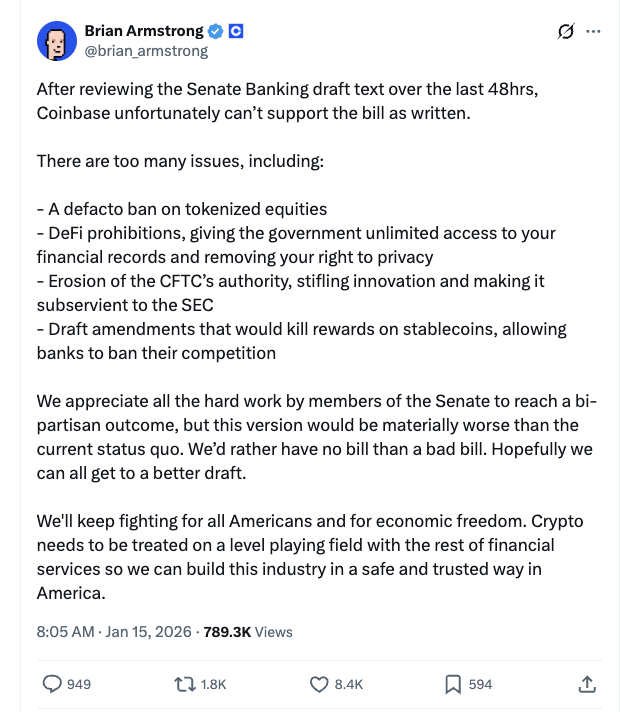
The industry was largely in favour of the Digital Asset Market Clarity bill, but it seems to have turned on the legislation after the latest round of drafts was reviewed. The major sticking points are rules around stablecoin rewards, decentralised finance, and tokenised assets, which could make things worse than the current system.
Stablecoins are a key point of debate, with the bill limiting interest payments for simply holding them to address banks’ concerns about financial stability, while still allowing rewards linked to payments or loyalty programs. The debate shows how difficult it is to balance consumer protection, innovation, and financial stability as the U.S. decides how to regulate crypto.
Eric Adams Facing “Rug Pull” Accusation for NYC Launch
A memecoin promoted by former New York City mayor Eric Adams sparked backlash after crashing sharply just minutes after launch. The token, called NYC Token (NYC), was launched on the Solana network and was promoted as a project aimed at fighting antisemitism and anti-Americanism. According to data from Dexscreener, the memecoin surged quickly to a market value of about US$540 million (AU$808 million) before collapsing roughly 80% within 30 minutes, falling to around US$87 million (AU$130 million). At the time of reporting, the token had partially recovered to about US$128 million (AU$191 million) but was still down around 75% from its peak, highlighting how quickly hype-driven tokens can move in crypto.

The sudden drop triggered accusations of a “rug pull,” a term describing a situation in which liquidity is removed from a project, leaving investors with heavy losses. Several well-followed analysts, such as RuneCrypto on X, claimed that Adams or wallets linked to the project withdrew liquidity, with estimates suggesting more than US$3 million (AU$4 million) may have been withdrawn. Community notes were added to Adams’ promotional post, repeating these allegations and noting that whilst Adams’ social media post celebrating the launch of the coin, liquidity had already been withdrawn.
At this stage, we would like to remind everyone at this point that what’s on Twitter isn’t always true.
The statement was summarised by the Financial Post and highlighted that Eric Adams didn’t profit from the launch, no investor funds were moved and that he personally didn't move any investment funds. They also stated that liquidity changes were needed to address overwhelming demand.
This isn't the first memecoin to face, or be accused of, “rug-pulling.” We have previously reported on issues with Yeezy’s initial coin launch and the famous Hawk Tuah incident, which left the meme coin market slightly jaded but not knocked out.
CoinGecko Weighs Sale (Allegedly)
CoinDesk reports that CoinGecko, one of the most widely used crypto price and data platforms, is considering a sale. The rumoured sale of the site is valued at around US$500 million (AU$747 million). According to CoinDesk, the company has hired investment bank Moelis to advise on the process, although discussions are still in the early stages and a final valuation has not yet been confirmed. CoinGecko, founded by Tim Lee and Bobby Ong in 2014, is a core tool for crypto aficionados, and many of us check in with It for pricing, tracking, market data, and more over our morning coffee. We have reported on multiple accusations, surveys, and data on reporting, which provide valuable insights into the industry.
Crypto acquisitions were a hot trend in 2025, when mergers and acquisitions accelerated rapidly. In 2025 alone, disclosed crypto deals reached about US$8.6 billion (AU$12.8 billion) across a record 133 transactions, according to TradingView, surpassing the total for the previous four years combined. Major moves included Coinbase acquiring Deribit for US$2.9 billion (AU$4.3 billion) and Kraken buying NinjaTrader for US$1.5 billion (AU$2.2 billion). If the rumours are indeed true, it will show that 2026 will also be a year that M&A’s in crypto run hot, hot.
The reality is that data aggregation sites like CoinGecko are seeing traffic decline as chatbots provide users with information. In 2020, CoinMarketCap was also facing declining audience numbers. Currently, CoinGecko’s monthly visits dropped to about 18.5 million in December 2025, down from 43.5 million in 2024.
Together, these trends highlight how the crypto data space is consolidating as the industry matures and competition for users intensifies. However, right now, this is just speculation and no need to post crying memes about private equity taking all the joy out of our lives. And rumours that CoinGecko is being acquired by Anthropic on crypto Twitter are just that at this point, so we should all take a little breather.
Although the news has been reported by CoinDesk and CoinTelegraph there has been silence from CoinGecko and Moelis. The alleged banker negotiating the trade has declined to speak publicly about whether this is happening or not.
Italy, India Tightens Regulations As South Korea Makes Big Moves
In what can only be described as “ERMMMM OK”, we have mixed messages across the world over whether crypto is getting a yay or nay.
Italy and India are tightening regulations around crypto, and South Korea, often criticised for its slow pace of regulatory change in this space, is relaxing some rules.
Starting with our Italian friends, the market watchdog, Commissione Nazionale per le Società e la Borsa (CONSBA), is warning Finfluencers (finance and crypto influencers generally) that promoting digital assets on social media is subject to full EU investment and advertising rules, not lifestyle marketing standards. The new standards are backed by guidance from the European Securities and Markets Authority (ESMA). Regulatory guidance stressed that disclaimers such as “not financial advice” do not shield influencers from liability, particularly when posts resemble personalised or directive investment recommendations. The move forms part of a broader European crackdown on unauthorised crypto promotions and undisclosed paid partnerships, as authorities step up enforcement following MiCA’s implementation and rising concerns over retail investor harm.
CoinDesk reports that India has tightened oversight of cryptocurrency exchanges by introducing stricter identity verification and compliance rules to curb money laundering and terrorist financing. Under new Financial Intelligence Unit guidelines, users must complete enhanced KYC checks, including live selfie verification, detailed location and device logging, and additional government-issued identification, while high-risk clients face more frequent due diligence. Exchanges are also barred from supporting ICOs or using transaction-obscuring tools, must register with the FIU, report suspicious activity, and retain user data for five years, reinforcing India’s cautious regulatory stance toward crypto as a regulated digital asset rather than legal tender.
And finally, South Korea is planning to allow companies and professional investors to buy crypto again under strict rules, ending a nearly decade-long institutional ban. The country’s financial regulator, the Financial Services Commission, has proposed guidelines that would allow firms to invest up to 5% of their equity in digital assets each year, limited to the top 20 cryptocurrencies by market value, with stablecoins still under review. The changes could be finalised in the first few months of the year, with trading starting before the end of 2026. Regulators also plan to use measures like split trades and price limits to control volatility as institutional money returns. The shift follows a year in which about US$110 billion (AU$166.1 billion) in crypto assets left South Korea due to restricted participation, and is expected to mainly benefit Bitcoin and Ethereum, while putting South Korea on a different path to Hong Kong and Japan, which have recently tightened corporate crypto rules.
Iran and Venezuela: What Does It Mean for Crypto
CoinGecko has reported that US$182 million (AU$272 million) in USDT on the TRON network, an action widely linked to Venezuela’s oil trade under U.S. sanctions. Reports suggest Venezuela’s state oil company used USDT to receive payments while ordinary citizens relied on the same stablecoin to protect their savings as the local currency collapsed. This shows how stablecoins can help people survive economic hardship while also being used by governments to avoid international financial controls.
A similar pattern has appeared in Iran, with Blockchain analysis firm TRM Labs saying networks linked to the Islamic Revolutionary Guard Corps moved more than US$1 billion using USDT through offshore exchanges, describing the activity as organised and ongoing rather than isolated misuse. According to The Defiant in their “Daily Newsletter”, this has led to a two-layer crypto system. Stablecoins like USDT and USDC are permissioned, meaning issuers can freeze funds and work with law enforcement. In contrast, decentralised networks like Bitcoin and Ethereum cannot be censored at the protocol level, allowing individuals to move money freely under restrictive regimes. While Chainalysis estimates that stablecoins now make up 84% of illicit crypto activity, illegal transactions still account for less than 1% of total usage. The challenge for regulators is to manage this balance without undermining crypto’s role as both a global financial tool and a means for people to protect their economic freedom.
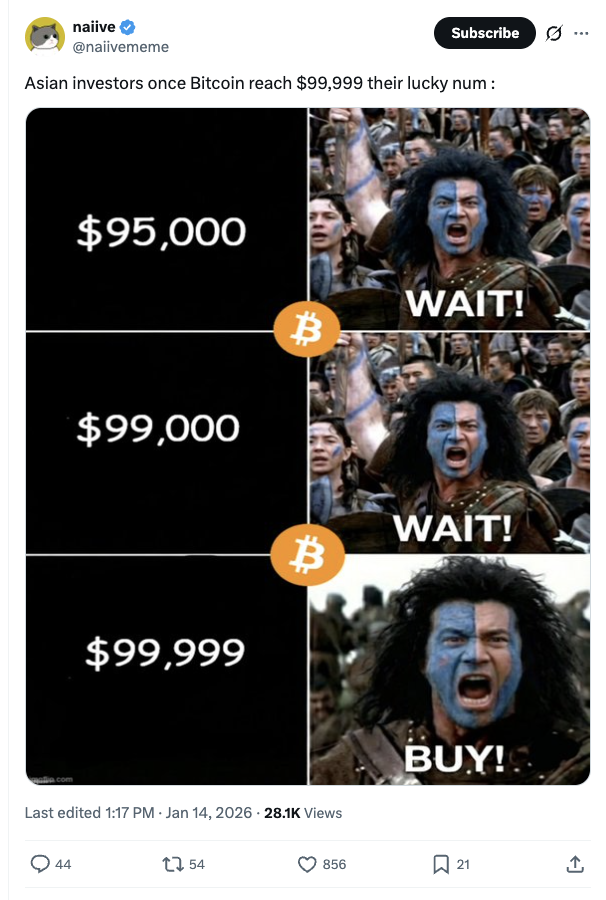
Things That Made Us Laugh This Week


Founder's Corner
This week in crypto again showed the constant tension between optimism and reality. Bitcoin pushed back toward the US$100,000 level on renewed hopes of U.S. regulatory clarity, and personally, it was encouraging to see this kind of price movement after the recent market sell-offs. The rally, driven by a draft U.S. Senate bill aimed at defining when crypto assets are treated as securities or commodities, is another clear reminder that regulation, not hype, remains one of the strongest forces shaping price action globally.
That said, the enthusiasm quickly met resistance. Coinbase’s decision to withdraw support for the bill in its current form highlights how fractured the industry has become over key issues such as stablecoins, DeFi, and tokenised assets. In my view, this doesn’t kill the case for regulatory clarity, but it does show that getting “good” regulation is harder than simply getting any regulation. Progress is happening, just not in a straight line.
At the same time, the speculative side of crypto reminded everyone why caution still matters. A high-profile memecoin launch tied to a public figure surged and collapsed within minutes, reinforcing how fragile hype-driven tokens remain. Alongside this, rumours around consolidation in the crypto data space suggest the industry is maturing, even if it’s uncomfortable. Globally, regulators are pulling in different directions, Europe and India tightening rules, South Korea reopening the door to institutions, while stablecoin activity in sanctioned economies underlines crypto’s dual role as both a financial lifeline and a regulatory challenge. Crypto is growing up, but it’s doing so loudly, unevenly, and in full public view.
Richard Voice, Wayex, Co-Founder
**All information in this article is for informational purposes only. You should not construe any such information or other material as legal, tax, investment, financial, or other advice. Nothing contained herein shall constitute a solicitation, recommendation, endorsement, or offer by Wayex to invest, buy, or sell any coins, tokens, or other crypto assets. Any descriptions of Wayex products or features are merely for illustrative purposes. Past performance is not a guarantee or predictor of future performance. The value of crypto assets can increase or decrease, and you could lose all or a substantial amount of your purchase price. It is essential for you to do your research and due diligence to make the best possible judgement, as any purchases shall be your sole responsibility.