Crypto markets were busy this week as Bitcoin tried to recover, only for Jerome Powell to quickly cool the momentum. Bitcoin pushed higher after the rate cut, but the rally faded when Powell warned that inflation is still a problem. At the same time, global events added pressure. Japan’s rising bond yields and large national debt have created new risks for crypto, while regulators in the United States and Australia sparked fresh debates. Even so, the industry saw vigorous activity from major players. Tom Lee increased his Ethereum buying, SpaceX’s large Bitcoin stack became part of the world’s most expected IPO, and Vitalik Buterin publicly criticised Elon Musk in a rare move.
Regulation and adoption were also major topics. The Australian Bitcoin Industry Body challenged the ABC for what it says is outdated reporting. CoinGecko revealed the top crypto trends of 2025, showing that meme coins and AI remain the market leaders. In the United States, progress on a new crypto law slowed after the teachers' union argued it could put retirement funds at risk. Meanwhile, India became a primary focus for builders. Polygon announced plans for an INR stablecoin, and Coinbase reopened registrations after a two-year hiatus. Together, these moves show that crypto is shifting fast and that global markets, regulators and large companies all have a hand in shaping what happens next.
What's Happening On The Wayex Platform This Week
Bitcoin Recovers, Then Powell Decided To Cancel The Party
Bitcoin spent Wednesday chopping around macro headlines. It briefly pushed above US$94,000 (AU$140,886) following the Federal Reserve’s 25-basis-point rate cut, but the move faded once Jerome Powell warned that the fight against inflation is far from finished. Powell also noted that the labour market might be softer than expected, which gave traders mixed signals. BTC slipped back toward US$92,000 (AU$137,888) while ETH held steady above US$3,300 (AU$4,951).
CoinDesk reported that the rate cut highlighted that the Fed is now close to a neutral policy range and is prepared to wait for more data before making another move. The New York Fed also announced up to US$40 billion (AU$59 billion) in short-term Treasury purchases over the next month to ease financial conditions. However, Powell clarified that this is not a new round of quantitative easing. Some economists expect only two more cuts by mid-2026. For Bitcoin, the key level remains at US$94,500 (AU$141,723), where concentrated short pressure continues to cap upside. Stronger spot ETF inflows could be the catalyst that finally sends BTC back toward the US$100,000 ($AU149,972) psychological barrier.
Trading View reported that on-chain data support the idea that volatility is far from over. The short-term holder supply ratio has risen from 18.3% to 18.5%, giving speculative traders more influence over short-term price action. Their tendency to take profit quickly adds liquidity but often limits recovery rallies. Supply in profit has climbed from 66.5% to 67.3%, which is an improvement but still well below the 98.4% conditions seen in intense bull phases. This aligns with an early-stage accumulation environment where investors are waiting for stronger macro signals.
Right now, as of 11:30 am AEDT, Bitcoin is trying to flip US$91,700 (AU$147,394) into support. A clean bounce could set up a move toward US$95,000 (AU$142,385) and, if that breaks, open the door to US$100,000 (AU$149,879). The risk is that short-term holders sell into strength, which could push BTC back toward US$86,800 (AU$130,094) and invalidate the bullish setup.
Keeping An Eye On Japan
Japan is moving on all fronts this week as markets monitor its high debt levels and its changes to its financial services legislation. Bitcoin briefly rebounds, but the rebound faces fresh pressure from both the US Federal Reserve and Japan. Japan has become a significant source of global market risk, and the markets are nervously awaiting how the Japanese waters will turn. Why? The reason is the surging cost of Japanese bond yields, including the two-year rising above 1% for the first time in 17 years and the 20-year hitting 2.947%, which have already triggered unwinds in yen-funded carry trades and pushed traders out of risk assets like Bitcoin. Japan’s heavy national debt, worth around US$10.2 trillion (AU$15.3 trillion) or 263% of GDP, means rising interest costs may force the country to bring hundreds of billions of dollars back home, reducing liquidity for crypto, Tether, and even US Treasuries. Analysts warn that if yields stay above 2.9%, Bitcoin could drop 5% to 8%, with US$87,000 (AU$130,394) as a possible downside target. At the same time, Japan is preparing its most significant overhaul of crypto oversight in almost a decade, shifting regulation from the Payment Services Act to the Financial Instruments and Exchange Act, essentially treating crypto like traditional securities. The Financial Services Agency reports that over 86% of Japanese users now trade crypto for long-term gains, with platform deposits above five trillion yen, prompting stricter rules on token disclosures, mandatory code audits, insider trading standards, and risk assessments for even decentralised assets. Exchanges will face tighter controls, including limits on unaudited token offerings and requirements to assess user risk levels. At the same time, custody providers and software vendors will need registration following the DMM Bitcoin breach. Banks and insurers still cannot run exchanges directly. Still, their subsidiaries will be allowed under strict supervision, and Japan is advancing both a joint stablecoin pilot with its three largest banks and a tax reform that will replace the progressive rate of up to 55% with a flat 20% tax on crypto gains from 2026. Together, rising bond yields and sweeping regulatory changes make Japan one of the most critical global forces shaping crypto heading into 2026.
Tom Lee Buys Ethereum Amidst ‘Supercycle’ Talk
Bitmine Chair Tom Lee has continued buying Ethereum, adding another US$435 million (AU$652 million) worth in early December as the company’s stock rose 45% from last month’s lows. Lee says the long-term crypto “supercycle” is still intact, suggesting crypto is in a long, powerful growth phase rather than a short bull run. He points to Ethereum’s recent Fusaka upgrade, which went live on 3 December and improves how the network handles transactions, boosts security, and makes apps easier to use across the US$376 billion (AU$563 billion) ecosystem. Bitmine now owns 3.2% of all ETH and aims to reach 5%, with support from major investors such as Founders Fund and ARK. Ethereum has climbed nearly 20% from its November lows and trades around US$3,276 (AU$4,916) as of 12 pm AEDT, although it remains significantly below its all-time high. Lee compared this moment for Ethereum to 1971, when the United States ended the gold standard, a significant shift that reshaped global finance. He says that large institutions such as BlackRock, JPMorgan, Deutsche Bank, and the Bank of China building on Ethereum signals a similar turning point today. Lee also highlighted tokenisation, which means converting traditional financial assets into blockchain-based tokens, as a key driver of Ethereum’s future growth. As we say here often, it's always good to take price prediction and Analysts' predictions with a grain of salt. But, if you are interested, Blockworks compiled some of Tim Lee’s forecasts so you can check his historical accuracy.
SpaceX + Bitcoin = IPO ?
SpaceX’s push toward a public listing at a potential US$1.5 trillion (AU$2.2 trillion) valuation is emerging as one of the most significant crypto-linked events on the horizon, especially given the company's central Bitcoin treasury. Arkham Intelligence identifies a wallet cluster labelled “SpaceX” holding about 3,991 BTC, worth roughly US$369 million (AU$556 million) at a Bitcoin price of US$92,500 (AU$138,638). These holdings have moved with market cycles, rising through the 2021 to 2022 bull market, dropping during the downturn, and rebuilding across 2024 and 2025. Recent internal transfers of more than 1,000 BTC each suggest treasury reshuffling rather than active buying or selling, but markets continue to closely track Musk-linked movements. SpaceX has also used Dogecoin to fund missions such as DOGE-1, underscoring Musk’s long-standing interest in digital assets. A public listing would give SpaceX new capital to expand Starlink and build data infrastructure that overlaps heavily with AI and blockchain. At the same time, prediction markets on Polymarket currently give a 67% chance that the IPO will debut at US$1 trillion (AU$1.5 trillion) or more.
In a separate development, Ethereum co-founder Vitalik Buterin publicly criticised Elon Musk for contributing to rising hostility on X, adding to the tension between two of crypto’s most influential figures. Musk’s companies remain major players in digital assets, with Tesla holding more than 11,000 BTC, and his public statements continue to move markets, particularly for dogecoin. If SpaceX enters public markets with a sizeable Bitcoin treasury and strong influence across both crypto and AI infrastructure, Musk’s role in shaping digital asset narratives could grow even further.
Australian Bitcoin Lobby Fires Back At Aunty
The Australian Bitcoin Industry Body (ABIB) has formally challenged the ABC after a column by chief business correspondent Ian Verrender described Bitcoin as having “no useful purpose” and linked its “last useful business” to money laundering. As a massive fan of the ABC, I’m obviously devastated to see that ABIB and Aunty are fighting (regular readers know I love a Twitter brawl). The source of this issue is an article published on ABC, which focused heavily on Bitcoin’s price drop from US$126,000 (AU$190,650) to below US$90,000 (AU$136,170) and framed the asset primarily through volatility and political narrative. ABIB argues this coverage breaches the ABC’s own editorial standards by relying on outdated stereotypes and ignoring significant developments such as Bitcoin’s growing institutional adoption. For example, the group notes that Verrender failed to mention that Bitcoin is now BlackRock’s biggest revenue generator through its spot ETF, the iShares Bitcoin Trust (IBIT).

ABIB’s submission identifies the sentences it considers inaccurate, outlines where it believes ABC policy was breached, and calls for corrections, adherence to editorial obligations, and future reporting guided by subject-matter experts. The group says it will continue fighting for “accuracy and integrity in public discourse” around Bitcoin, especially as Australia moves toward formal crypto regulation. In November, Treasurer Jim Chalmers and Financial Services Minister Daniel Mulino introduced the Corporations Amendment (Digital Assets Framework) Bill 2025, the country’s first complete regulatory framework for companies that custody digital assets. The government says blockchain and digital assets represent significant opportunities for the economy, estimating the reforms could deliver about AU$24 billion in annual productivity gains while strengthening consumer protections.
CoinGecko Reviews Trends of 2025
According to new reporting from CoinGecko, meme coins and AI are the two biggest crypto narratives of 2025, accounting for 46% of global investor interest. Meme coins stayed in the number one spot for the second year in a row with 12.48% interest, although this is slightly lower than 14.36% in 2024. Solana meme coins (4.57%), AI meme coins (1.51%) and Base meme coins (1.40%) also made the top 20. AI was the fastest-growing theme, rising to a combined 22.39% share, with AI agents posting the most significant jump of all narratives, climbing from 1.17% to 5.03% in one year.
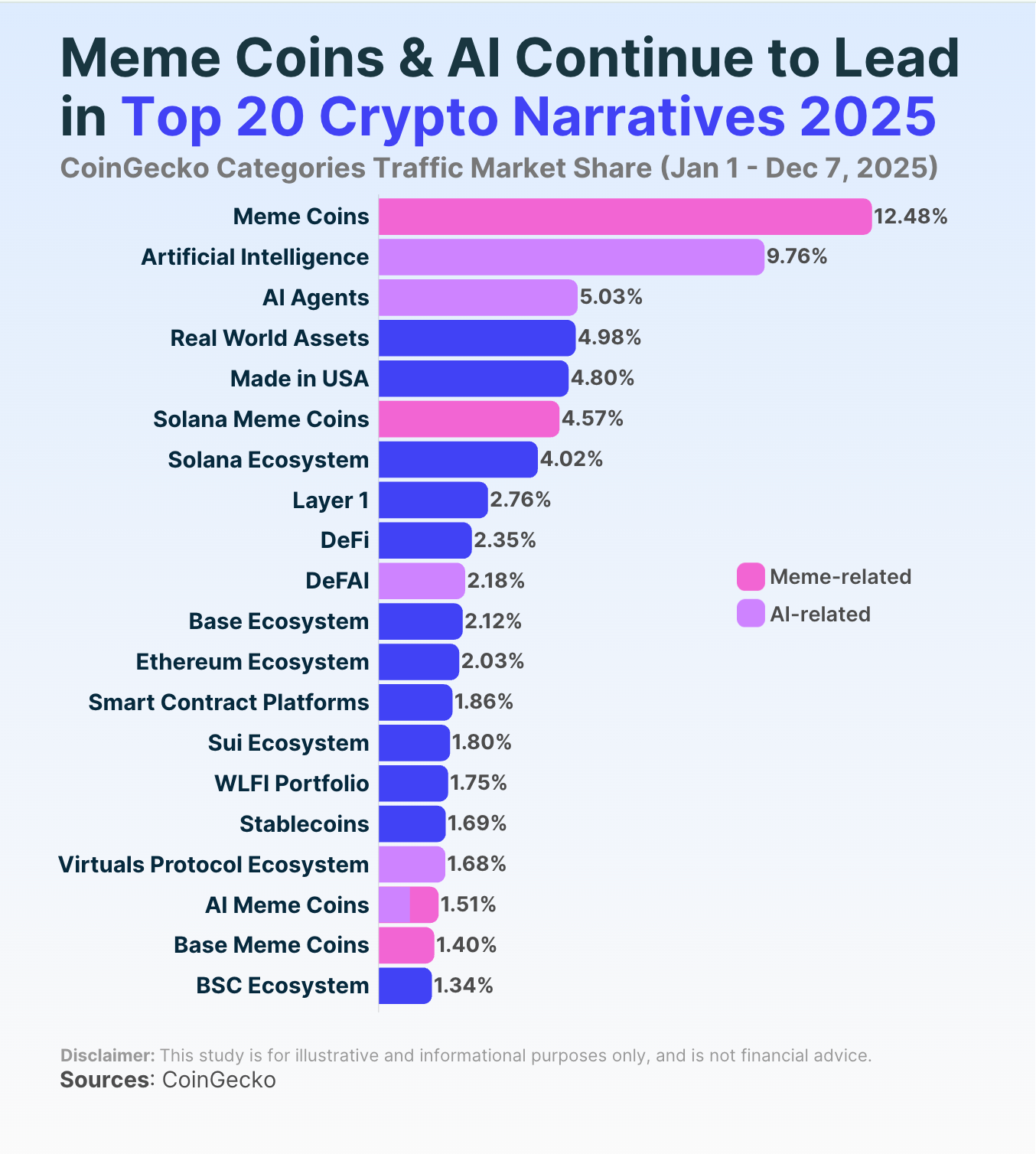
Real-world assets (RWA) saw the most significant drop, falling from 8.64% to 4.98%, and several once-popular narratives dropped out of the top 20, including gaming, DePIN, layer 2s, BRC-20 and cat meme coins. Meanwhile, stablecoins saw a significant rise, jumping from 31st to 16th place, and the Virtuals Protocol ecosystem recorded the most crucial overall improvement, moving from 56th to 17th with a 1.68% share. In total, the top 20 narratives accounted for 70.11% of global interest in 2025, indicating that attention is now spread across more themes than in previous years. You can find the full report, including an explanation of their research methodology, here.
US Crypto Market Bill Hits Teacher Roadblock
U.S. lawmakers are still trying to build a clear rulebook for crypto, but progress has stalled because regulators cannot agree on who should oversee which parts of the market. The SEC wants to treat many tokens like stocks, while the CFTC views others as commodities. A new bill is meant to settle this fight and define what rules exchanges and intermediaries must follow. Still, Senator Bernie Moreno says negotiations have been “frustrating” and insists he would rather have no law than one that harms the industry. The Senate’s draft would split SEC and CFTC responsibilities and create a new category, “ancillary assets,” to recognise tokens linked to broader blockchain projects.
The debate escalated after the American Federation of Teachers (AFT), representing 1.8 million workers, strongly opposed the current draft. The union argues the bill is risky for retirement funds, weakens existing investor protections, and could allow companies to tokenise their stocks in ways that bypass securities rules. They warn that this could expose pensions to unsafe assets and fail to stop fraud in crypto markets. The AFL-CIO has also raised concerns, and major banks like Bank of America, Citi, and Wells Fargo are now weighing in. With Democrats divided on tokenisation, oversight and how much power to give each regulator, the Senate still needs at least seven Democratic votes for the bill to pass. Senator Cynthia Lummis says a revised draft may arrive this week, but a final agreement remains distant.
Polygon Bets On Stablecoin-Backed Future In India
India’s crypto market is entering a new phase as both domestic builders and global exchanges return. Polygon and ANQ Finance are developing an INR-backed stablecoin with input from Indian policymakers, aiming for a January 2026 launch. The token will start fully backed by cash and fixed deposits and use Polygon’s ARC infrastructure to support remittances, on-chain assets and improved CBDC usability. With India now the world’s largest stablecoin market, yet with less than 2% of volume flowing through local exchanges, Polygon says a compliant, India-issued stablecoin could address oversight gaps and unlock innovation across UPI, CBDC, and blockchain rails.
At the same time, Coinbase has reopened registrations in India after a two-year pause caused by regulatory pressure. The exchange plans to restore a rupee on-ramp in 2026, even as India maintains a harsh tax regime with a 30% tax on crypto income and 1% TDS on every trade, generating US$818 million (AU$1.2 billion) in government revenue since 2022. Despite these hurdles, India ranks first worldwide for overall crypto adoption, pulling major platforms like Binance and Bybit back into the country. Together, Polygon’s stablecoin push and Coinbase’s return show that India is shifting from offshore activity toward a regulated, domestic digital-asset ecosystem.
Things That Made Us Laugh This Week



Founders Corner
Some weeks in crypto feel like progress. This was not one of them; this was a reminder that the market can’t rally for more than five minutes before Jerome Powell pops up to say, “Not so fast.” Bitcoin finally showed some strength, pushed upward… and then Powell stepped in and basically told everyone to sit back down. Add Japan’s bond market blowing up carry trades, and regulators taking turns grandstanding, and you’ve got the perfect recipe for a momentum killer.
But here’s the part the headlines always miss: while the market panics, the smartest players in the room are quietly doubling down. Tom Lee is loading up on ETH like it’s the early 2000s internet boom. SpaceX is heading toward a trillion-dollar IPO with a fat Bitcoin stack on its balance sheet. Vitalik is openly calling out Musk, which tells you how high the stakes have become between the people actually shaping the next financial system.
Globally, the moves are even louder: India is becoming a stablecoin superpower, Coinbase is slipping back into the country after two years, and Polygon is building rails the government is actually paying attention to. Meanwhile, Australia is still having Twitter fights about whether Bitcoin has “a purpose.”
The noise comes and goes. The volatility never leaves. But innovation? That’s only speeding up, and I am all for it.
**All information in this article is for informational purposes only. You should not construe any such information or other material as legal, tax, investment, financial, or other advice. Nothing contained herein shall constitute a solicitation, recommendation, endorsement, or offer by Wayex to invest, buy, or sell any coins, tokens, or other crypto assets. Any descriptions of Wayex products or features are merely for illustrative purposes. Past performance is not a guarantee or predictor of future performance. The value of crypto assets can increase or decrease, and you could lose all or a substantial amount of your purchase price. It is essential for you to do your research and due diligence to make the best possible judgement, as any purchases shall be your sole responsibility.