.png)
This week in crypto has been one for the history books, where politics, regulation, and market pressure collided on a global scale. Bitcoin is cooling near $108,902 USD ($165,388 AUD) per CoinGecko as of 4:20 pm AEDT. Altcoins remain mixed as traders eye key resistance zones. In Washington, President Trump’s pardon of Binance founder CZ Zhao reignited fierce debate over political influence and ethics in the crypto space. At the same time, Australia tightened its digital-asset rules, introducing new licensing and custody standards to strengthen consumer protection. S&P Global’s first-ever rating of MicroStrategy underscored how traditional finance is grappling with corporate Bitcoin exposure, and Western Union’s Solana-based stablecoin launch signalled another step toward mainstream blockchain payments. Across the Atlantic, France stunned Europe by rejecting the digital euro in favour of Bitcoin reserves and euro-backed stablecoins. At the same time, Mastercard is planning to acquire Zero Hash for $2 billion USD ($3 billion AUD). Pump. fun’s memecoin expansion highlighted how fast the line between finance and crypto is blurring. With so much unfolding at once, Moonvember isn’t just a market moment; it’s a turning point for the global digital-asset era.
What’s Happening On The Wayex Platform This Week
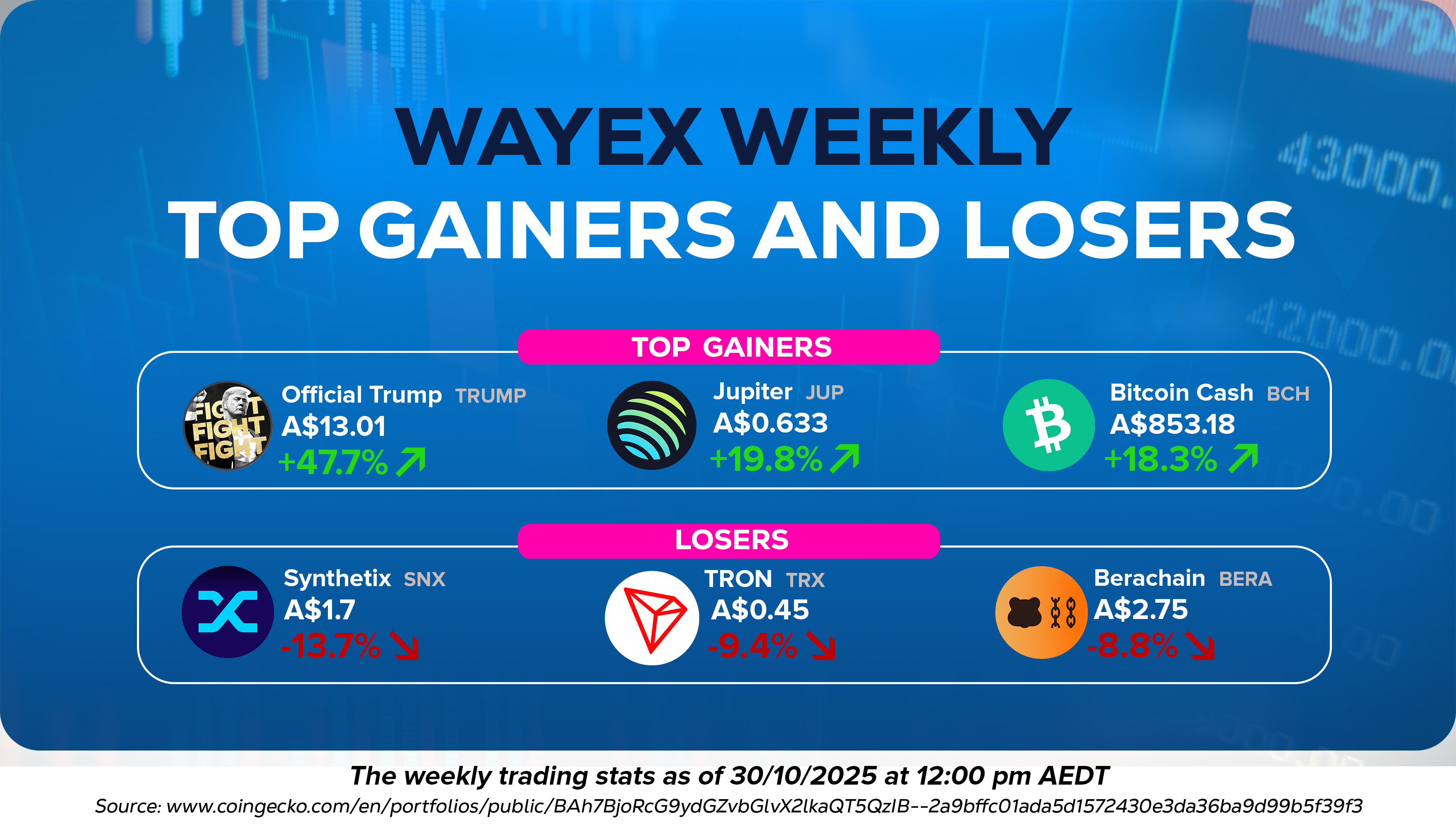
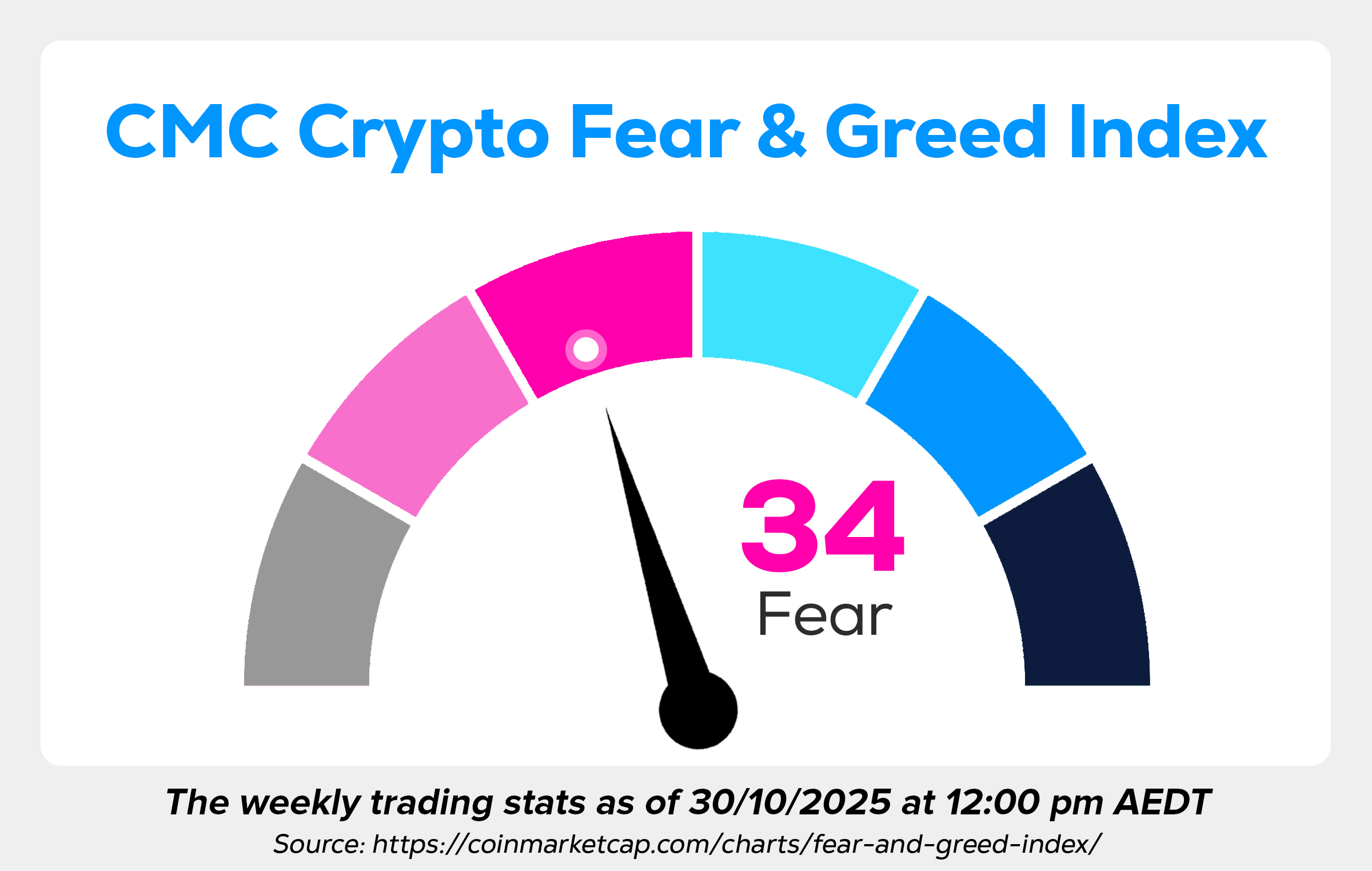
Moonvember The Next Goal Post
Bitcoin’s recovery rally is losing steam near $108,902 USD ($165,388 AUD), showing that sellers still dominate the market. Galaxy Digital CEO Mike Novogratz expects Bitcoin to trade between $100,000 USD ($151,942 AUD) and $125 000 USD ($189,927) before any major breakout. Some analysts predict a dip to around $104,000 USD ($158,019 AUD) following the Federal Reserve’s commentary that a rate cut may not occur in December 2025. However, TradingView cited Nick Rubin of LVRG Research, who believed that strong fundamentals and institutional demand would keep the long-term bull trend intact. Major altcoins like Ethereum, BNB, XRP, Solana, Dogecoin, Cardano, Chainlink, Stellar, and Hyperliquid are showing mixed signals. Buyers are defending key support levels, but most need to break through short-term resistance zones to confirm a lasting rebound.
The Pardon Of All Pardons
Former Binance CEO Changpeng Zhao (CZ) was pardoned by President Donald Trump on October 21, 2025, for failing to maintain an effective anti-money-laundering program at Binance. Zhao had served a four-month prison sentence following a 2023 guilty plea, while Binance paid $4.3 billion USD ($6.5 billion AUD) in fines for helping users bypass U.S. sanctions. The White House described the move as correcting the Biden administration’s “war on cryptocurrency.”
Zhao’s pardon was something Binance had aggressively campaigned for, according to reporting by Politico and CryptoDNS, which reported that Binance had spent $860,000 USD ($1.3 million AUD) since President Trump’s return to office.
It is not the first pardon for a crypto-affiliated industry figurehead, as President Trump previously pardoned Ross Ulbricht, founder of Silk Road; however, Binance’s Zhao’s pardon has raised more than a few eyebrows.
Major Republican donors, including Palantir Co-Founder Joe Lonsdale, a prominent figure in the Conservative movement, criticised the move.
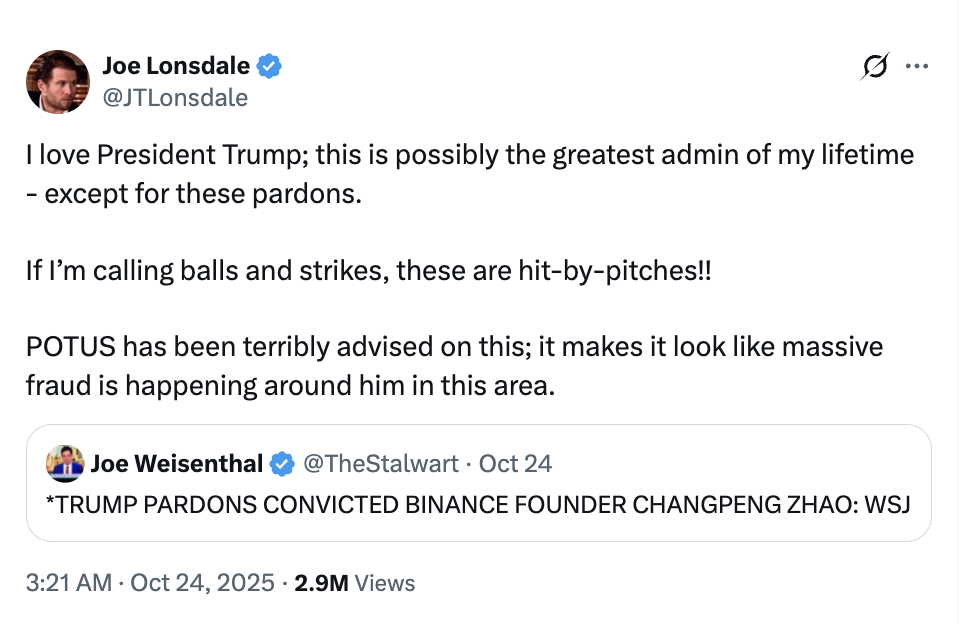
At the same time, critics noted that Binance’s investment in Trump’s own crypto venture, World Liberty Financial, raised serious conflict-of-interest concerns. Ethics experts, including former White House lawyer Richard Painter, called the pardon one of the most troubling examples of political and financial entanglement between a president and private business interests.
In an announcement that could only be described as “Hmmmm”, Binance US has announced the listing of Trump family-connected tokens WLF1 and USD1 from October 29, 2025. The pardon from Trump paves the way for CZ to return to the forefront of Binance’s operations in the USA.
Australia Tightens Its Digital Asset Rules
Australia has strengthened its digital-asset rules as it prepares for new crypto licensing laws aimed at improving consumer protection and clarity. The Australian Securities and Investments Commission (ASIC) has updated its guidance to show how existing financial laws apply to digital assets, including stablecoins and staking services. The move aligns with the Treasury’s Digital Asset Platforms Bill and Payment Service Providers Bill, which will introduce official licences for exchanges, stablecoin issuers, and custodians by 2026. ASIC has also tightened custody standards, requiring firms to hold at least 10 million AUD in net tangible assets and confirming that offshore crypto platforms must follow Australian law if they serve local users. The regulator will allow skilled crypto professionals to qualify for licences and may offer temporary relief for firms transitioning to the new system. Assistant Treasurer, Daniel Mulino, said the reforms aim to create transparent, secure, and innovation-friendly laws for Australia’s digital economy.
Micro Strategy Vs The Ratings Agency
S&P Global has given MicroStrategy (MSTR) a B- rating, making it the first Bitcoin treasury company to be rated by a major credit rating agency. The rating means the company’s finances are considered risky because it holds most of its money in Bitcoin and has limited cash in U.S. dollars. Even though a B- rating is classified as “junk” status, Executive Chairman Michael Saylor called it a big step towards Bitcoin being considered a normal financial asset. Strategy now operates mainly as a public company that buys and holds Bitcoin, using its extra cash and borrowed funds to buy more. Some people in the crypto industry say this is an exciting move that could one day attract more big investors.
S&P said that while Mico Strategy’s $70 billion USD ($167 billion AUD) in Bitcoin holdings are much larger than its $15 billion USD ($34.9 billion AUD) in debt, it doesn’t have much actual cash to use. A significant drop in Bitcoin's price could be a problem for MicroStrategy, as the company’s debts are in U.S. dollars while its assets are in Bitcoin, creating a “currency mismatch.” Strategy also owes about $640 million USD ($421 million AUD) in dividends on preferred shares each year, though it plans to pay these by issuing new shares rather than selling Bitcoin. Despite the risks, S&P kept a stable outlook, saying Strategy has managed its debts well so far and doesn’t have any principal repayments due until 2028. However, the agency warned that the company’s success still depends heavily on Bitcoin’s price staying strong. Despite the ratings, MicroStrategy stock reacted positively to the news; however, this may prompt publicly listed companies to rethink their crypto treasury strategies to avoid downgrades from ratings agencies.
Western Union Announces Solana Partnership
The global payments giant announced plans to launch a U.S. dollar–backed stablecoin, called the U.S. Dollar Payment Token (USDPT), on the Solana blockchain in early 2026. It will be issued by Anchorage Digital Bank, a U.S.-regulated digital-asset bank known for its secure custody and compliance standards. Western Union will use USDPT across its 100 million-user network, enabling people to send money around the world faster and more cheaply than with traditional methods.
This move puts Western Union alongside big names like PayPal and MoneyGram, who already use stablecoins for cross-border payments. The stablecoin market is now worth around $300 billion USD ($455 billion AUD) and could grow to $750 billion USD ($1.06 trillion AUD) by 2026. With the new GENIUS Act providing clear rules for issuing and trading stablecoins, more companies and governments are entering the space. For crypto fans, this is another big sign that blockchain-based payments are going mainstream.

But Crypto Twitter was absolutely BUZZING with the Western Union’s Ripple’s XRP snub. The company began testing XRP in 2015 to explore faster, cheaper cross-border payments. However, by 2018, multiple pilot programs showed that XRP didn’t outperform Western Union’s existing systems. Transaction fees were higher than expected, and the overall performance failed to deliver real efficiency gains. As a result, the partnership quietly faded.
Western Union CEO Devin McGranahan said the move reflects a focus on institutional-grade infrastructure, explaining: “For an institutional use case like ours, Solana was the right choice.” XRP holders are not happy, Jan, but we’ll have to see how this plays out.
Crypto Goes To Washington
Coinbase's CEO was in Washington this week, meeting with Senators from both parties about the Market restructuring bill. The industry is sceptical that the market restructuring bill will pass this year; however, Brian Armstrong, Coinbase's CEO, remains confident despite the shutdown.
Cryptocurrency has become a significant player in Washington, with high-profile Democrats such as Elizabeth Warren and Bernie Sanders accusing it of being a wing of the Republican Party.
Industry-leading crypto companies have also been in the spotlight for outsized donations to the Republican Party and Trump. Ripple, Coinbase, Tether and Gemini were reportedly among the list of donors to President Trump’s ballroom project.
Senators Elizabeth Warren and Bernie Sanders, along with several Democrats, have criticised the Trump administration’s plan to let 401(k) retirement accounts invest in cryptocurrencies, calling it “dangerous” and risky for American workers’ savings. In a letter to the SEC and the Department of Labour, they warned that exposing the 31 trillion USD retirement industry to volatile digital assets could cause significant financial harm, especially after the reversal of Biden-era protections. The senators cited government studies comparing crypto investing to gambling and raised concerns about Trump’s personal ties to the industry, suggesting his family could profit from the move. Additionally, a California Democrat has proposed a bill that would ban Trump, his family, and members of Congress from buying, selling, or promoting crypto projects. However, the bill can’t move forward until Congress reopens, but it's definitely one to watch.
Acquisition Season For Crypto
Memecoin launchpad Pump.fun and payments giant Mastercard both made major crypto moves this week, highlighting the growing convergence between traditional finance and blockchain. Pump.fun announced its acquisition of Padre, a multichain trading terminal operating across Solana, Base, Ethereum, and BNB Smart Chain, as part of its strategy to dominate the memecoin trading ecosystem. The deal sent PUMP up 9%, while PADRE crashed 78% after news that its token would lose all utility, sparking outrage from holders, but promised an airdrop to holders as a Mea Culpa to address some of the outrage.
Meanwhile, Mastercard is reportedly in late-stage talks to acquire Zero Hash. Zero Hash is A crypto and stablecoin infrastructure startup valued between 1.5 and 2 billion USD. This move signals the company’s biggest stablecoin bet yet. Following Stripe’s 1.1 billion USD acquisition of Bridge and Coinbase’s talks with BVNK, Mastercard’s interest underscores how major financial players are racing to integrate stablecoin and blockchain infrastructure into global payment systems, positioning themselves for a future in which digital assets underpin both retail and institutional finance.
France Makes Waves In Crypto
France has surprised Europe by voting to reject the European Central Bank’s plan for a digital euro and instead support Bitcoin and euro-backed stablecoins. The resolution, led by lawmaker Éric Ciotti, says a digital euro could threaten people’s privacy, freedom and financial stability, comparing it to China’s digital yuan. Lawmakers want to create a national Bitcoin reserve of around 420,000 coins funded through public mining and seized assets, and even allow tax payments in Bitcoin. They also want to back euro-based stablecoins to reduce Europe’s reliance on US dollar-backed ones like USDT and USDC, which currently dominate the global market. As France prepares for new crypto rules in 2026, this move could make it a leader in pro-crypto policy and a challenger to the European Union’s centralised digital plans.
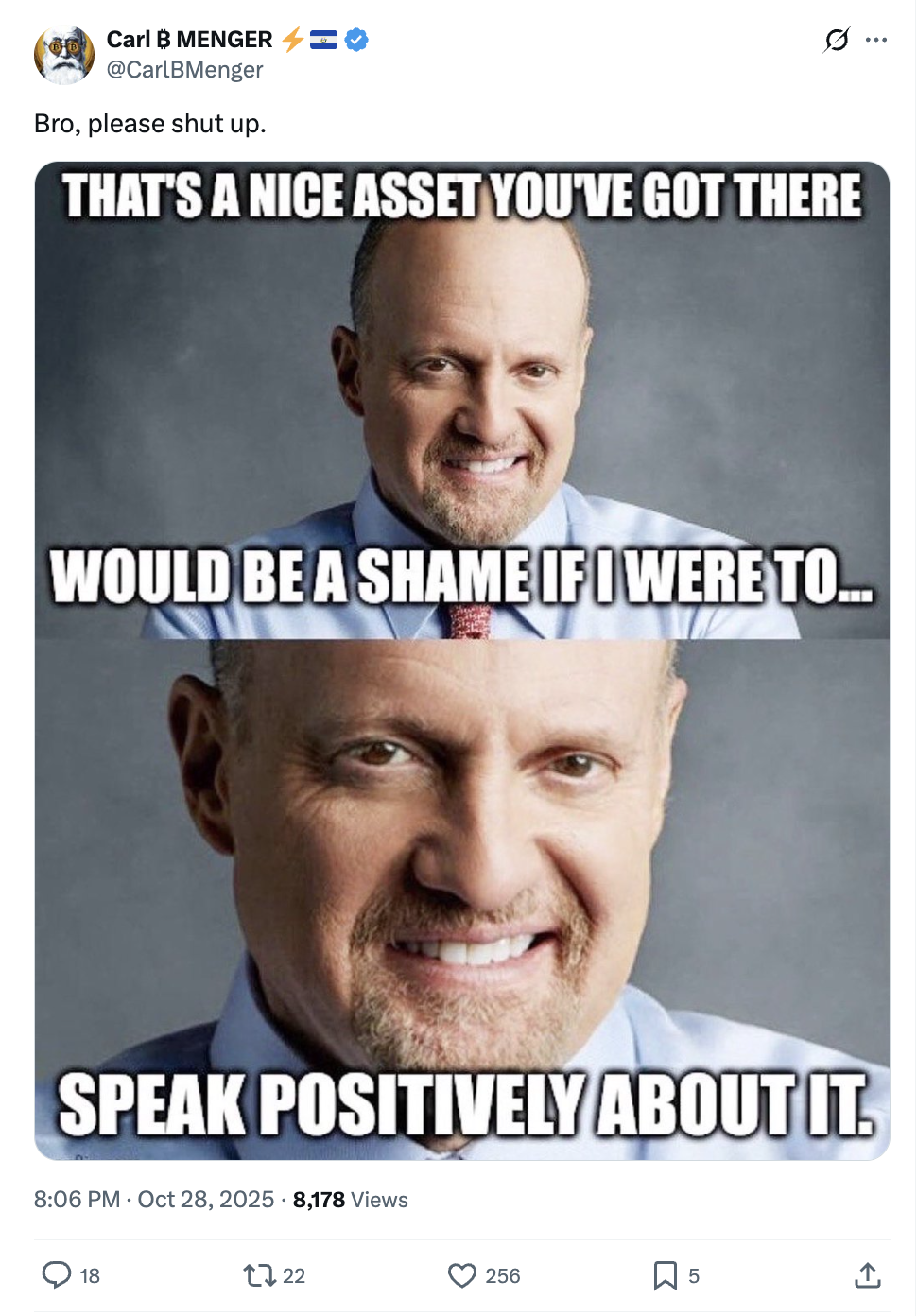
Things That Made Us Laugh This Week


Founder's Corner
This week, the crypto market wasn’t just moving, it was evolving. Bitcoin cooled off near $108,902 USD ($165,388 AUD) on CoinGecko as of 4:20 pm AEDT, a sign that early gains are meeting realistic expectations and profit-taking is setting in. Meanwhile, politics and regulation were front and centre: Changpeng Zhao’s pardon by Donald Trump reignited debate over crypto ethics, and Australia’s tightened digital-asset rules reminded us that compliance isn’t optional —it’s foundational.
We have been waiting for ASIC to introduce additional regulation in the crypto space to provide clarity and enhance the safety of Australian consumers. We do need to keep an eye, however, on where the line is between the innovation of Australian crypto companies and what barrier to entry is too high for this innovation to take place.
Richard Voice, Co-Founder, Wayex
**All information in this article is for informational purposes only. You should not construe any such information or other material as legal, tax, investment, financial, or other advice. Nothing contained herein shall constitute a solicitation, recommendation, endorsement, or offer by Wayex to invest, buy, or sell any coins, tokens, or other crypto assets. Any descriptions of Wayex products or features are merely for illustrative purposes. Past performance is not a guarantee or predictor of future performance. The value of crypto assets can increase or decrease, and you could lose all or a substantial amount of your purchase price. It is essential for you to do your research and due diligence to make the best possible judgement, as any purchases shall be your sole responsibility.